A head of supply chain tells you her integrations break every time a system changes, and she wants to know, in plain terms, what SAP would do about it. You have one answer to give and three pillars to choose from. That conversation, compressed into a single scored activity, is the Positioning SAP Business AI Platform certification. Its exam code is C_BCBTP, and if that code looks familiar, it is because the same code used to belong to the exam for positioning SAP Business Technology Platform as part of SAP Business Suite.
This article explains what changed when the exam took its new name, what the credential validates and for whom, how one Scenario Based Assessment activity is scored over two hours, what the ten blueprint areas on the ERPPrep study guide ask of you, how the Build, Contextualize and Reason, and Govern pillars decide a pitch, which platform products you must be able to position, how C_BCBTP relates to the sibling exams C_BCSBS and the retired C_BCBAI, and how to prepare with the three-course learning journey SAP built for it.
Why Was the BTP Positioning Exam Renamed to SAP Business AI Platform?
C_BCBTP was renamed because the product it positions was renamed. At SAP Sapphire in May 2026, SAP introduced SAP Business AI Platform as a single governed environment that unifies SAP Business Technology Platform, SAP Business Data Cloud and SAP Business AI. The certification that once taught sellers to position BTP as part of SAP Business Suite now carries the title SAP Certified – Positioning SAP Business AI Platform, under the same C_BCBTP code.
The earlier version was published as C_BCBTP_2502 with the title SAP Certified – Positioning SAP Business Technology Platform as part of SAP Business Suite. Older preparation pages, including SAP’s own Stay Certified live session, still use that wording, which is why a search for the credential returns two names for one exam. SAP’s certification page today shows the plain code C_BCBTP and the new title, with no release suffix on display.
What the rename added to the scope
The platform capabilities a BTP seller already knew are still in the blueprint: data integration, analytics and visualization, application development, end-to-end processes, industry value, clean core and identity integration. Around them sit three areas that carry the new title’s AI framing: the autonomous enterprise vision and the shift to AI-centred software delivery, positioning the platform through its three pillars, and AI agents with their customer value. In SAP’s own framing, the platform is where agents are built, contextualized and governed, and the exam now expects you to present it that way.
If you prepared for the 2502 version, treat this as a different exam with a familiar core. The products are mostly the same. The story you are asked to tell about them is not.
What Does the Positioning SAP Business AI Platform Certification Validate?
The Positioning SAP Business AI Platform certification validates that you can explain, to a customer, why SAP Business AI Platform matters, what it is made of, and how it is applied to a business problem. SAP describes it as an entry-level qualification that confirms foundational knowledge of the platform. It is a credential for people who sell and advise, not for people who configure.
SAP lists Sales and Presales as the roles on the certification page, and the learning journey behind it adds customer engagement executives, marketing and business users. ERPPrep’s study guide describes the same audience: sales and presales professionals, plus marketing, customer-engagement and business-user roles, and consultants starting out on the platform. The skills SAP attaches to it are Analytics, Application Development and Data Integration, which are the three long-standing BTP capability areas the blueprint still carries.
Positioning, not configuration
Nothing in this exam asks you to build an integration flow or deploy an application. What it asks is whether you can hear a business constraint and connect it to the right platform capability without over-claiming. ERPPrep’s sample drills show the shape: a named company with a stated objective and a stated constraint, a presales consultant who must frame the value, and four possible framings, only one of which actually addresses the constraint. The platform is built around C_BCBTP scenario simulations that rehearse exactly that judgement, with 24 full scenarios and 224 skill drills behind the free sample.
That is why the credential suits a seller eight weeks into an SAP role and a consultant moving from delivery into presales equally well. Both need the same thing: a reliable way to turn “our data is trapped in six systems” into a platform conversation that holds up when the customer pushes back.
How Is One Scenario Based Assessment Activity Scored?
C_BCBTP is delivered as a Scenario Based Assessment consisting of one activity, scored against a 60 percent cut, with two hours shown on SAP’s certification page. There is no question count because there is no question bank: you work through a single business situation and your positioning choices are scored against the objectives behind it. SAP completed its move to performance-based certification in early 2026, and this exam is one of the scenario-based kind.
SAP runs two formats of scenario-based assessment, and C_BCBTP’s language rule depends on which you book. The certification page states that available languages vary by format: Roleplay with AI guidance is offered in English, Spanish, Italian, French, Japanese and 25 more languages, while Record a video is offered in English only. ERPPrep lists English, which is correct for the recorded format and incomplete for the roleplay one, so check the format you intend to use before assuming you must present in English.
What a seller should expect on the day
SAP names the two formats Roleplay with AI guidance and Record a video, and its certification page links an introduction to scenario-based assessments that walks through how each runs. In both, the scoring is about whether your framing matched the stated business need, led with the right pillar, and stayed honest about what the platform does and does not do. SAP requires a Learning Hub subscription that includes certification attempts and an SAP Universal ID, publishes a Technical Readiness Checklist for the hardware and connectivity you need, and offers an AI-powered scenario-based assessment tool to try before you sit the real one.
Two hours is generous for a single activity, and that is the point. The time is there for you to read the situation carefully, decide which capability actually answers the constraint, and structure a value story, not to race through a list of items.
Which Ten Blueprint Areas Does C_BCBTP Cover?
The ERPPrep study guide for C_BCBTP lists ten blueprint areas, and SAP publishes no weightings for any of them. Three are new with the Business AI Platform title: the autonomous enterprise vision, the three pillars, and AI agents and customer value. The other seven carry the BTP positioning scope forward: data integration, analytics, application development, key products, end-to-end processes, industry value, and clean core with identity integration.
Because no area has a percentage attached, the honest way to plan is by objective. Each row below gives the area as named on the study guide and the question a scenario is likely to put to you within it.
| Blueprint area | What a scenario asks you to do |
|---|---|
| Autonomous Enterprise Vision and the AI-Era Shift | Explain how SAP frames the move toward an autonomous enterprise and why software delivered as a service is being rethought with AI at the centre |
| Positioning SAP Business AI Platform Through Its Three Pillars | Present the platform through Build, Contextualize and Reason, and Govern, and pick the pillar to lead with for a stated priority |
| AI Agents, Business AI Use Cases and Customer Value | Say where an AI agent genuinely resolves a business problem and use customer examples rather than abstract capability lists |
| Data Integration | Position how the platform connects SAP and non-SAP systems so information flows across the landscape |
| Analytics & Data Visualization | Articulate how the platform surfaces insight from business data and why that matters more once AI depends on it |
| Application Development | Position low-code and pro-code tooling that extends core ERP while keeping the digital core clean |
| Key Platform Products & Portfolio | Distinguish SAP Integration Suite, SAP Build Code, SAP Business Data Cloud and SAP AI Core and tie each to an outcome |
| End-to-End Business Processes | Show how the platform carries a process across several systems from start to finish |
| Positioning Platform Value for Industries | Connect platform capability to the pains of one sector so the story is recognisable to that customer |
| Clean Core and Identity Integration | Explain the reasoning behind clean core and the synergy with SAP Customer Identity and Access Management in customer-facing scenarios |
Notice how many rows begin with a verb of explanation rather than a verb of action. That is the register of the whole exam. You are scored on the quality of a framing, so a correct product name attached to the wrong business need earns nothing.
Build, Contextualize and Reason, Govern: Which Pillar Do You Lead With?
The three pillars of SAP Business AI Platform are Build, Contextualize and Reason, and Govern, and the C_BCBTP blueprint asks you to know which one to open with when a customer’s stated priority is delivery speed, grounded intelligence, or control and oversight. ERPPrep’s FAQ names this pillar story as the part candidates find hardest, because it requires connecting several ideas rather than recalling one.
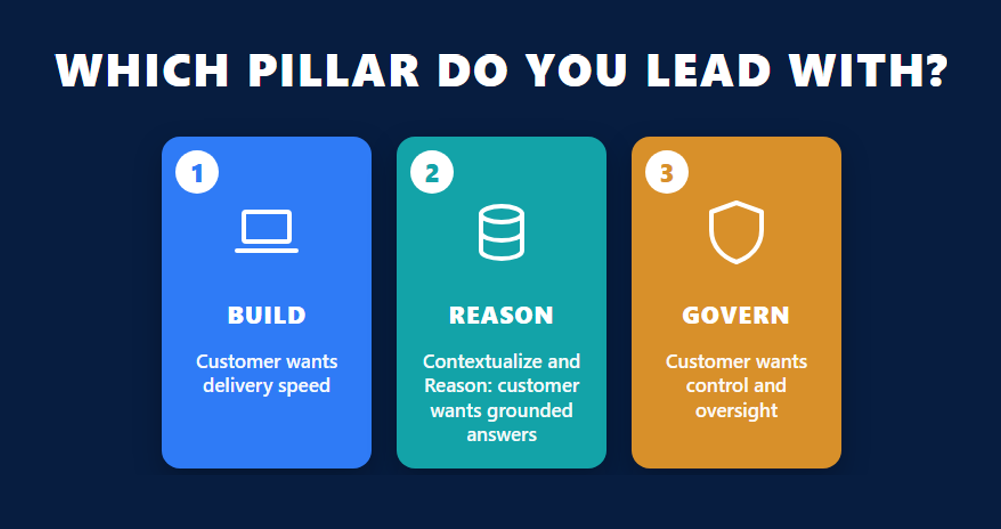
The pillars are not three products. They are three answers to three different anxieties, and a positioning scenario usually tells you which anxiety is in the room.
Build: when the pain is speed
A customer who keeps missing market windows because capabilities take too long to ship is asking a Build question. The platform story here is about creating agents, applications and workflows quickly, with no-code and pro-code choices, on infrastructure SAP manages. Leading with governance in this conversation sounds like an excuse for slowness.
Contextualize and Reason: when the pain is trust in the answer
A customer whose data sits in disconnected systems, or whose earlier AI pilots produced confident nonsense, is asking a Contextualize and Reason question. The platform story is about grounding AI in real business context, with SAP Knowledge Graph giving agents a structured map of business entities, processes and relationships. Here, leading with speed is the wrong opening, because fast and ungrounded is what they already tried.
Govern: when the pain is control
A customer in a regulated sector, or one whose board has asked who is accountable for what an agent does, is asking a Govern question. The platform story is about oversight of agents, access and outcomes. Leading with how quickly you can ship agents is precisely the wrong note.
In practice the three overlap, and a strong answer touches all of them in an order that matches the customer’s priority. The exam rewards the order as much as the content.
Which Platform Products Does the Exam Expect You to Position?
The Key Platform Products area on the C_BCBTP study guide names four building blocks: SAP Integration Suite, SAP Build Code, SAP Business Data Cloud and SAP AI Core. You are expected to distinguish them in a customer scenario and show, through examples, how each delivers a business outcome. The learning journey page additionally lists SAP Integration Suite as the product associated with the credential.
Each maps cleanly to one of the long-standing capability areas, which is the easiest way to keep them apart under pressure.
- SAP Integration Suite answers the Data Integration area: a managed layer of governed, reusable, monitored connections instead of brittle point-to-point links.
- SAP Build Code answers the Application Development area: faster application delivery with productive tooling and reusable services beside the suite, without modifying the core.
- SAP Business Data Cloud answers the Analytics and Data Visualization area: one trusted data foundation ready for analysis, decisions and, increasingly, for grounding AI.
- SAP AI Core answers the AI agents and Business AI area: the runtime side of building and operating AI in the platform.
Products SAP talks about that the syllabus does not name
SAP’s Sapphire announcement put Joule Studio and SAP Knowledge Graph at the centre of the platform story, and the Build and Contextualize and Reason pillars are described through them. The ERPPrep study guide does not list either as a named product area. Know what they are, because a scenario may describe them without naming them, but anchor your positioning in the four products the blueprint actually names.
Where Do AI Agents and the Autonomous Enterprise Fit in a Positioning Scenario?
AI agents and the autonomous enterprise are the frame that holds the C_BCBTP syllabus together. SAP positions the platform as the foundation of what it calls the Autonomous Enterprise: a unified AI platform for building, contextualizing and governing agents, an autonomous suite that executes core operations, and a new way for people to work with enterprise software. The exam asks you to describe how an autonomous enterprise draws on AI to grow and stay resilient, and to say where an agent genuinely helps.
SAP’s chief executive set out the positioning in those terms when the platform was announced.
“For the mission-critical processes of our customers, ‘almost right’ just isn’t good enough. By uniting SAP Business AI Platform with SAP Autonomous Suite, we anchor AI agents in the business processes, data and governance so they can deliver accurate, compliant and secure outcomes, unlocking new sources of revenue and meaningful cost savings.”
Read that as a positioning template. Accuracy comes from context, compliance comes from governance, and the commercial outcome is named last. The study guide’s fifth preparation step says the same thing from the other side: be able to say where an AI agent resolves a problem and where it does not, because vague AI enthusiasm is exactly what a positioning scenario is designed to expose.
Why governance language is part of the pitch
Customers who have read any public guidance on AI risk will ask governance questions early. The NIST AI Risk Management Framework organises that conversation around governing, mapping, measuring and managing AI risk, and a seller who can place the platform’s Govern pillar against that vocabulary sounds like someone who has done this before. Likewise, the agent ecosystem is standardising: the Linux Foundation formed the Agentic AI Foundation around the Model Context Protocol and related projects, which is the kind of context that lets you explain why an open, governed platform for agents matters to a customer who fears lock-in.
None of this is tested as trivia. It is tested as the difference between a seller who says “we have agents” and one who can explain what the agents are grounded in and who is accountable for them.
What Are the C_BCBTP Exam Facts?
C_BCBTP is an associate-level, entry-level SAP certification delivered as one Scenario Based Assessment activity, scored at a 60 percent cut, with two hours displayed on SAP’s page and a language list that depends on the format you choose. SAP publishes no fee, no question count, no topic weightings and no validity period on the certification page, so none appear below.
| Detail | Value | Source |
|---|---|---|
| Exam code | C_BCBTP | ERPPrep study guide, SAP certification page |
| Current title | SAP Certified – Positioning SAP Business AI Platform | ERPPrep study guide, SAP certification page |
| Earlier title and code | SAP Certified – Positioning SAP Business Technology Platform as part of SAP Business Suite, C_BCBTP_2502 | Earlier ERPPrep and ERPQnA pages |
| Level | Associate, described by SAP as an entry-level qualification | ERPPrep study guide, SAP certification page |
| Format | Scenario Based Assessment, 1 activity | ERPPrep study guide, SAP certification page |
| Passing score | 60 percent | ERPPrep study guide, SAP certification page |
| Duration | 2 hours | SAP certification page (ERPPrep publishes none) |
| Languages | Vary by format: Roleplay with AI guidance in English, Spanish, Italian, French, Japanese and 25 more; Record a video in English only | SAP certification page (ERPPrep lists English) |
| Roles | Sales, Presales; journey adds CEE, Marketing, Business User | SAP certification and learning journey pages |
| Product scope | SAP Business AI Platform, including SAP Business Technology Platform capabilities | ERPPrep study guide |
| Blueprint areas | Ten, unweighted | ERPPrep study guide |
| Learning journey | Positioning SAP Business AI Platform; prerequisite journey Discovering the Autonomous Enterprise | SAP learning journey page |
| Booking requirements | Learning Hub subscription with certification attempts, SAP Universal ID | SAP certification page |
The SAP certification page is the place to re-check the duration, the cut score and the language banner before you book, because those are the fields SAP displays and can change.
How Should You Prepare for C_BCBTP?
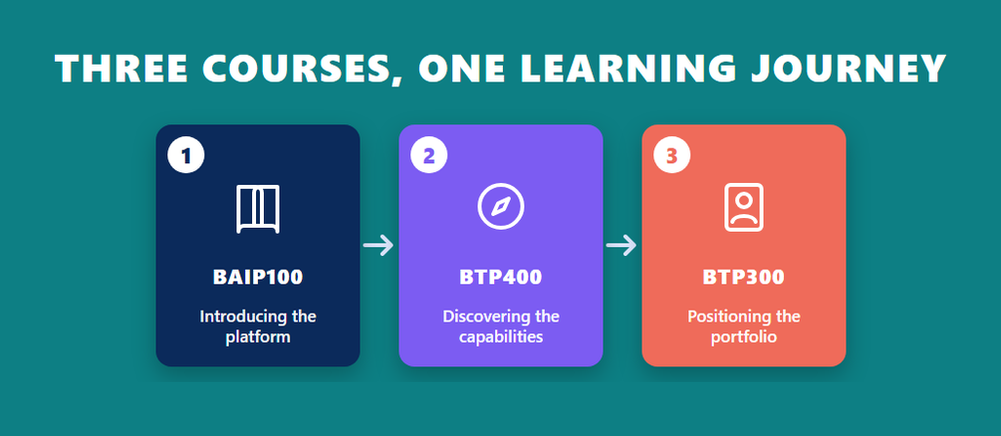
Prepare for C_BCBTP by completing the three-course Positioning SAP Business AI Platform learning journey in order, then rehearsing whole positioning conversations rather than memorising product definitions. The ERPPrep study guide lists SL_BAIP100, SL_BTP400 and SL_BTP300 as the courses the certification draws on, and SAP’s journey page names Discovering the Autonomous Enterprise as its prerequisite. No system access is needed; the exam tests judgement, not configuration.
The three courses and what each gives you
SL_BAIP100, Introducing SAP Business AI Platform, is the beginner course that opens the journey: the autonomous enterprise, how SAP evolved as AI reshaped software delivery, the platform itself and the three pillars, and the value customers draw from it. SL_BTP400, Discovering SAP Business Technology Platform, covers the capability areas now carried inside the platform, why data value matters more in an AI era, and customer use cases. SL_BTP300, Positioning SAP Business Technology Platform, is the intermediate course on portfolio fit, end-to-end processes, industry value, the main products, integration through SAP Integration Suite, clean core and SAP Customer Identity and Access Management. The SAP learning journey page lists the outcomes the three are meant to produce.
A preparation sequence built from the study guide
- Learn the platform as one connected value story, linking data integration, analytics and visualization, and application development, so that you can show how a single business challenge draws on more than one capability at once.
- Study SAP Integration Suite, SAP Build Code, SAP Business Data Cloud and SAP AI Core together, practising how you would distinguish and position each one in a specific customer scenario.
- Rehearse leading with each of the three pillars in turn, building, contextualizing and reasoning, and governing, so you can pick the right opening for a customer focused on delivery speed, on grounded intelligence, or on control and oversight.
- Practise reading a business context and mapping it to the right end-to-end or industry process before choosing a value story, because the scenario format rewards interpretation over recall.
- Be able to say where an AI agent genuinely resolves a business problem and where it does not, and tie that back to how an autonomous enterprise uses intelligence to grow and stay resilient.
Candidates who sat the earlier version will find the earlier C_BCBTP preparation guide on this site still useful for the seven carried-over areas, with the caveat that it predates the pillars and the agent material. Read it for the BTP capability story, then add the AI layer from SL_BAIP100.
How long it takes
SAP does not display a duration for the learning journey, so plan by readiness rather than by hours. A reasonable test is whether you can take any one of the ten blueprint areas, invent a customer with a constraint in that area, and talk for three minutes about which pillar you would lead with and which product answers the constraint, without reaching for a slide. When you can do that for all ten, you are ready for one activity.
How Does C_BCBTP Relate to C_BCSBS and the Retired C_BCBAI?
C_BCBTP is one of three positioning credentials SAP has offered for sellers, and only two of them are current. C_BCSBS, Positioning SAP Business Suite, positions the suite and the autonomous enterprise as a whole; C_BCBTP positions the platform underneath it; and C_BCBAI, Positioning SAP Business AI Solutions as part of SAP Business Suite, has been retired, with its subject matter folded into C_BCBTP. Searching for any of the three tends to surface the other two.
ERPPrep’s own C_BCBAI page states that SAP no longer lists that certification and that its Business AI positioning scope is now covered by the Positioning SAP Business AI Platform exam. If you hold C_BCBAI, your knowledge of Joule and responsible AI is still relevant, but the current exam frames it inside the three pillars and the platform products rather than as a separate AI solutions story.
Which one a seller should take first
If you sell the suite, C_BCSBS is the broader credential and the one customers’ executives will recognise; the C_BCSBS autonomous enterprise pitch covered on this site earlier this month explains how that exam scores a suite-level conversation. If you sell or advise on the platform, integration, data and extension work, C_BCBTP is the one that matches your conversations. Many presales teams end up holding both, because a suite pitch that cannot answer a platform question stalls at the second meeting.
Neither exam is a prerequisite for the other. Both are single-activity Scenario Based Assessments, so preparation for one teaches you the format of the other.
Frequently Asked Questions
Is C_BCBTP the same exam as C_BCBTP_2502?
It is the same code with a new title and a wider scope. C_BCBTP_2502 was SAP Certified – Positioning SAP Business Technology Platform as part of SAP Business Suite. The current C_BCBTP is SAP Certified – Positioning SAP Business AI Platform, and it adds the autonomous enterprise vision, the three pillars and AI agents to the BTP positioning areas.
What does C_BCBTP_2606 refer to?
SAP’s certification page shows the exam code as plain C_BCBTP with no suffix. Suffixed forms such as C_BCBTP_2606 appear in searches and third-party listings, and the safest reading is that they point at the current exam. Book the exam shown on SAP’s page.
What is the C_BCBTP exam format?
One Scenario Based Assessment activity. You work through a single business situation and your positioning choices are scored against the objectives behind it. There is no question count.
What is the passing score for C_BCBTP?
60 percent, published by both ERPPrep and SAP.
How long is the C_BCBTP exam?
SAP’s certification page displays 2 hours. ERPPrep does not publish a duration for this exam.
Which languages is C_BCBTP offered in?
It depends on the format. SAP states that Roleplay with AI guidance is available in English, Spanish, Italian, French, Japanese and 25 more languages, while Record a video is available in English only.
What are the three pillars of SAP Business AI Platform?
Build, Contextualize and Reason, and Govern. The exam asks you to lead with the pillar that matches the customer’s stated priority: delivery speed, grounded intelligence, or control and oversight.
What is the difference between C_BCBTP and C_BCBAI?
C_BCBAI, Positioning SAP Business AI Solutions as part of SAP Business Suite, has been retired, and ERPPrep’s page for it says its subject matter is now covered by C_BCBTP. C_BCBTP is the current credential for positioning the platform, including its Business AI capabilities.
Is there a prerequisite for C_BCBTP?
SAP’s certification page lists no prerequisite certification. The learning journey behind the exam names Discovering the Autonomous Enterprise as its prerequisite journey, so complete that first if the autonomous enterprise framing is new to you.
Do I need SAP system access to prepare?
No. The exam tests positioning judgement, not configuration. The three-course learning journey plus rehearsed positioning scenarios is the preparation SAP and ERPPrep both point to.
Conclusion
The Positioning SAP Business AI Platform certification is the BTP positioning exam grown up: same C_BCBTP code, a new title, ten blueprint areas with three of them new, and a three-pillar story that decides how every conversation opens. It is delivered as one Scenario Based Assessment activity over two hours at a 60 percent cut, in a language that depends on the format you choose, and it expects you to distinguish SAP Integration Suite, SAP Build Code, SAP Business Data Cloud and SAP AI Core by the business problem each solves. Complete SL_BAIP100, SL_BTP400 and SL_BTP300 in order, then rehearse whole positioning conversations until you can lead with the right pillar without thinking about it. That is the skill the activity scores, and it is the same skill that closes the second meeting.


