Modern business processes such as procurement, production, sales, service, finance, controlling, and human resources are highly interconnected and characterized by numerous interfaces, dependencies, and dynamic integration points. Consistent master data usage and close cross-functional collaboration are essential to meet time, cost, and quality objectives.
SAP provides an integrated solution portfolio that supports these end-to-end business processes based on modern technologies and evolving business requirements. Due to the breadth and continuous evolution of the SAP portfolio, gaining an initial overview can be challenging. The objective is therefore to offer a structured understanding of SAP process terminology, integration concepts, and corresponding solutions.
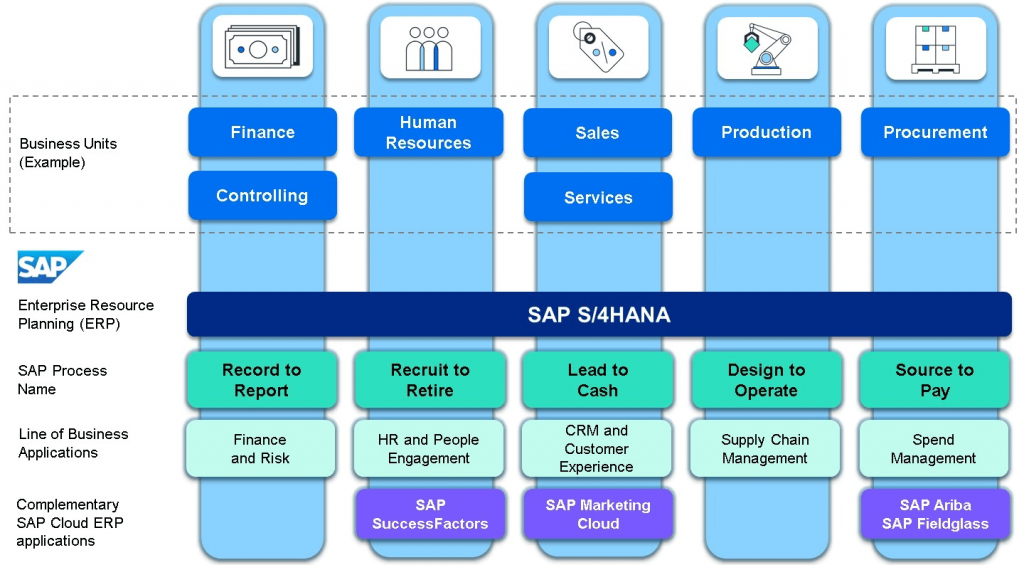
Finance as a core function of end-to-end business processes
Finance ensures the proper recording, processing and evaluation of all financial transactions of a company. It reflects the financial reality of operations and ensures compliance with legal, regulatory and country-specific accounting standards.
Duties and responsibilities
Its core tasks include the continuous posting of business transactions, the analysis of financial data and its structured reporting. Finance thus provides the basis for transparency, control and external reporting.
Central interfaces
Finance is closely interlinked with other areas of the company:
- Customers / Debtors: Receivables management and complaint support
- Sales: Early detection of credit risks and clarification of payment or delivery problems
- Procurement: Review of incoming invoices and management of accounts payable
These interfaces make finance an integrative cross-sectional function.
Typical results
- Periodic financial statements (balance sheet, profit and loss account, cash flow statement)
- Maintain and manage accounts receivable, vendor, and asset data
- Financial and liquidity reporting for management and controlling
Critical success factors
- High data quality and timely availability of financial information
- Transparent assessment of creditworthiness and payment behavior
- Compliance with compliance and risk management requirements
- Consistent master data and end-to-end system integration
Conclusion
Finance is a central integration point of end-to-end business processes. Incorrect or delayed data transfers have a direct impact on transparency, controllability and compliance.
Controlling as a management function of the company
Controlling supports management by planning, calculating, analysing and communicating financial information. It creates transparency about the economic situation of the company and serves as internal control, control and decision-making support.
Duties and responsibilities
The core tasks of controlling include internal planning, budgeting, control and reporting on the financial health of the company. The focus is on the analysis of costs, revenues and profitability as well as on the derivation of key performance indicators relevant to management.
Central interfaces
Controlling works closely with operational and market-related departments:
- Production: Cost and revenue control via cost accounting, budgeting of organizational expenses, and planning and estimating production costs
- Marketing and Sales: Providing information on sales variances to adjust sales campaigns or correct price ranges
Typical results
- Analysis results and management reports to assess financial soundness
- Cost, result and variance analyses
- Decision-making bases for improving cost accounting and financial planning
Critical success factors
- Effective, realistic planning and budgeting
- Accurate, consistent, and timely data
- Appropriate control and key performance indicator systems
Conclusion
Controlling is the central control body between operational business and management. The quality and timeliness of data as well as clearly defined control systems are crucial for effective corporate management and well-founded decisions.
Human Resources as a Structuring Business Process (R2R-Recruit To Retire)
Human Resources ensures that the company has qualified, efficient and motivated employees. It is responsible for all HR-related business processes along the entire employee lifecycle and thus makes a significant contribution to operational stability and strategic development.
Duties and responsibilities
Core responsibilities include recruiting employees with the right qualifications, onboarding new employees in a structured manner, and managing performance, training, and development opportunities. In addition, HR is responsible for payroll, pension and additional benefits as well as all other cost-relevant personnel topics. Another focus is on improving employee and professional experience.
Central interfaces
Human Resources is a cross-departmental cross-sectional function:
- All departments: Implement performance management systems, employee and benefits programs, and secure budgets for personnel and compensation changes
- Internal and external accounting: reconciliation of payroll, HR-related costs, accruals and budget planning
Typical results
- Employee surveys and evaluations
- Leadership, training, and development programs
- Proper payroll
- Culture, Health, and Employee Retention Programs
Critical success factors
- Clear strategic alignment of workforce and capacity planning
- Successfully attracting and retaining talent
- Effective, transparent performance management
- Reliable, integrated workforce data and processes
Conclusion in the context of business process analysis
Human resources is a central end-to-end business process . Media disruptions, a lack of integration with finance or unclear responsibilities have a direct impact on costs, employee satisfaction and performance. An end-to-end HR process is therefore an essential prerequisite for stable and scalable business processes.
See the deep dive for more Informations:

Procurement as an operational and strategic business process (S2P source-to-pay)
Procurement ensures that the company is supplied with goods and services in a timely manner, cost-efficiently and in suitable quality. It supports both operational operations and strategic value creation.
Duties and responsibilities
The core tasks of procurement include overseeing all goods and service requirements, selecting reliable suppliers, and concluding and managing supplier contracts. In addition, procurement procures items to support internal business operations and takes purchasing positions to manufacture products.
Central interfaces
Procurement is closely interlinked with commercial and operational areas:
- Controlling: Coordination for the planning and budgeting of order items
- Financial accounting: Close collaboration, as accounts payable is part of financial accounting
- Departments: Notification of requirements and use of purchasing catalogs
Typical results
- Available materials in stock
- Valid supplier contracts
- Standardized purchasing catalogs for employees
Critical success factors
- Strategic Sourcing and Effective Stakeholder Management
- Reliable, efficient and sustainable suppliers
- Efficient, transparent purchasing processes
Conclusion
Procurement is a central end-to-end business process that directly influences costs, delivery capability and productivity. Close integration with controlling and financial accounting as well as efficient, digitally supported processes are crucial for a stable supply and sustainable value creation.
See the deep dive for more Informations:
Sales as a revenue-driving end-to-end business process (L2C – Lead to Cash)
Sales is responsible for the sale of goods and services and is largely responsible for revenue generation and profitability. It covers the entire process from new customer acquisition to quotation preparation and order fulfillment.
Duties and responsibilities
The core tasks of sales include the acquisition of new customers, the maintenance of existing customer relationships and the implementation of presales activities. Sales creates quotes, takes customer orders, fulfills them in collaboration with the supply chain, and plans future sales.
Central interfaces
Sales is closely involved in cross-departmental processes:
- Marketing: Using marketing leads to create targeted offers and contracts
- Internal and external accounting: Reporting and reconciliation of revenues from customer orders
- Service: Support of service sales, e.g. through consulting or support services
Typical results
- Quotes and confirmed customer orders
- Long-term and sustainable customer relationships
- Revenue and sales plans
Critical success factors
- Effective sales estimates and realistic sales planning
- Seamless integration into the supply chain
- High customer satisfaction
- Sustainable revenue generation and increased profitability
Conclusion
Sales is a central end-to-end business process whose performance depends directly on integration with marketing, service, logistics and finance. Media disruptions or a lack of coordination have a direct impact on customer satisfaction, sales and margins.
See the deep dive for more Informations:
Production as a value-adding core process (D2O Design To Operate)
Production is responsible for the production of finished products using materials, machines and labour. The aim is on-time and high-quality production at the lowest possible cost – in the example of the Bike Company, the production of bicycles.
Duties and responsibilities
The core tasks of production include the conversion of materials into finished products and compliance with defined manufacturing processes. Standardised processes reduce production costs, ensure quality and meet delivery deadlines.
Central interfaces
Production is closely linked to commercial and upstream functions:
- Controlling / internal accounting: Estimation, planning and analysis of production costs
- Financial accounting: Reporting of production and cost data as well as optimization of product costs
- Procurement: Ensuring material availability through timely purchase of the required components
Typical results
- Finished bikes that meet quality standards
- Timely delivery of products
- Production and cost data for other divisions
Critical success factors
- Availability of materials, machines and personnel
- Efficient, stable production processes
- Minor variances between actual and planned costs
Conclusion
Production is the company’s central value-added process. Close integration with procurement, finance and controlling is crucial to controlling costs, ensuring quality and reliably guaranteeing delivery capability.
See the deep dive for more Informations:
Service as a customer-loyal end-to-end business process
The service ensures the maintenance, support and servicing of sold products . It makes a significant contribution to customer satisfaction, customer loyalty and long-term value creation.
Duties and responsibilities
The core tasks of the service include the execution of maintenance and services, the provision of round-the-clock support and the planning and handling of service visits. A central component is ensuring the availability of spare parts and qualified service staff.
Central interfaces
The service is closely interlinked with other company divisions:
- Sales: Sharing service histories, handling customer and support requests, and supporting service sales
- Procurement: Coordination to ensure that required spare parts are available and delivered within 24 hours
Typical results
- Round-the-clock support and service delivery
- Service visits carried out with spare parts and qualified service employees
- Fully documented service histories
Critical success factors
- Short response times and spare parts availability within 24 hours
- Effective planning of service costs and deadlines
- Use of digital technologies, e.g. Internet of Things (IoT) for premium bicycles
Conclusion
Service is a crucial end-to-end post-sale business process . Close integration with sales and procurement as well as data-based, digitally supported service processes are central to high customer satisfaction and sustainable customer relationships.
Process Integration
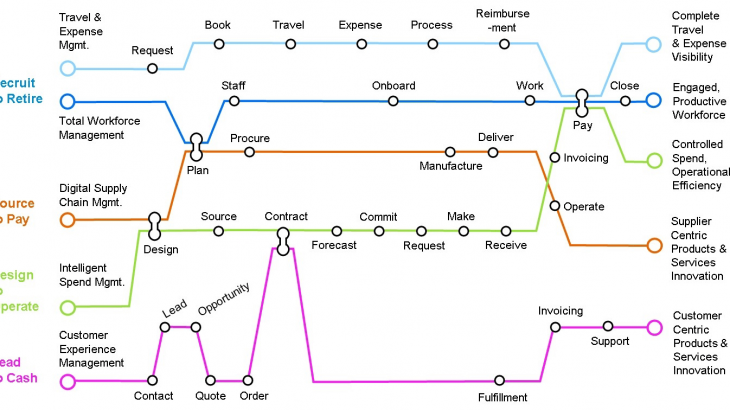
The following graphic illustrates process steps within the end-to-end processes Lead to Cash, Source to Pay, Design to Operate, Recruit to Retire and their main integration points.
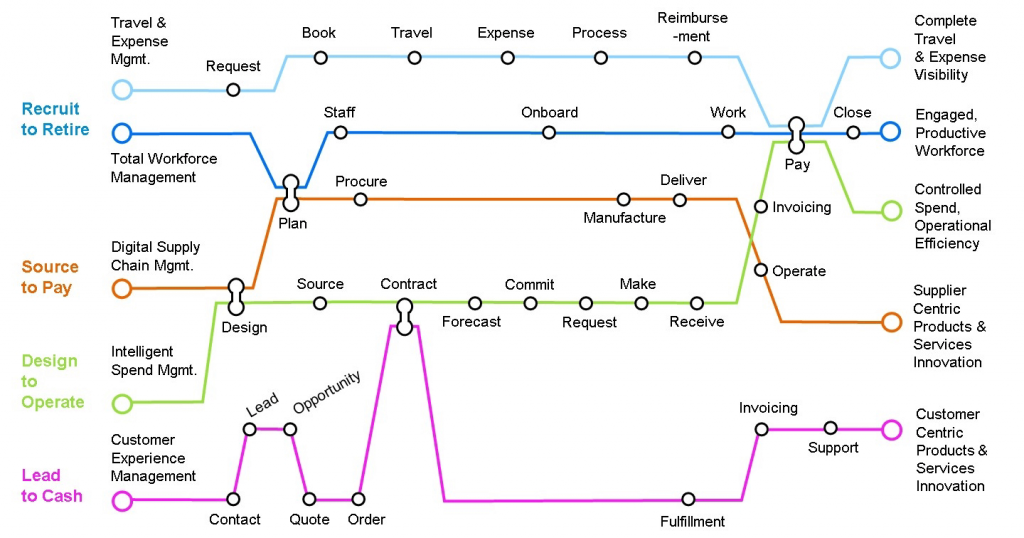
End-to-End Business Processes and Integration Challenges
SAP end-to-end (E2E) business processes cover the entire flow of a business function across departments, eliminating fragmentation. Sales, supply chain, procurement, finance, and HR are integrated into a single, intelligent workflow.
Key Benefits of SAP
- Integration: Unified platform connecting all core business functions
- Efficiency: Automation reduces manual effort and errors
- Data Consistency: Centralized data as a single source of truth
- Compliance: Built-in support for regulatory requirements
- Scalability: Flexible solutions that grow with the business
- Real-Time Insights: Up-to-date analytics for better decisions
- Customer Satisfaction: Faster, more reliable processes improve service quality


