The preparation method that carried candidates through the year-suffixed versions of this exam no longer works. C_TS452 is now delivered as a System-Based Assessment made up of one hands-on activity, which means you sit in front of a configured SAP system and carry out configuration and transaction tasks rather than working through a fixed bank of recall items. Reading the courses is still necessary. It is no longer sufficient. Candidates who want the broader cross-module view before specialising in procurement can start with the end-to-end business processes credential, which uses the same System-Based Assessment format across source-to-pay, lead-to-cash and the other core flows.
That single change reshapes everything else about the SAP sourcing and procurement certification: why the cut score sits at 76 percent instead of the 60 percent many SAP associate credentials use, why hands-on system access has stopped being optional, and why the areas candidates report struggling with are all places where an early setting quietly changes a later result. This guide walks the seven blueprint areas, explains what the activity actually asks, and sets out a preparation order built around doing rather than reading. The sales side of the suite changed in the same way, and the SAP SD certification explains how its 82 percent pass mark compares with the procurement exam.
What Is the SAP Sourcing and Procurement Certification?
C_TS452 is the associate credential for SAP S/4HANA Cloud Private Edition, Sourcing and Procurement. It validates that you can configure and operate the core procurement processes in S/4HANA at an associate level, across the full procure-to-pay flow, and it targets the consultant profile working in a mentored project role. Consultants who run procurement in Ariba rather than in S/4HANA have a parallel credential, covered in our look at the SAP Ariba consultant exam.
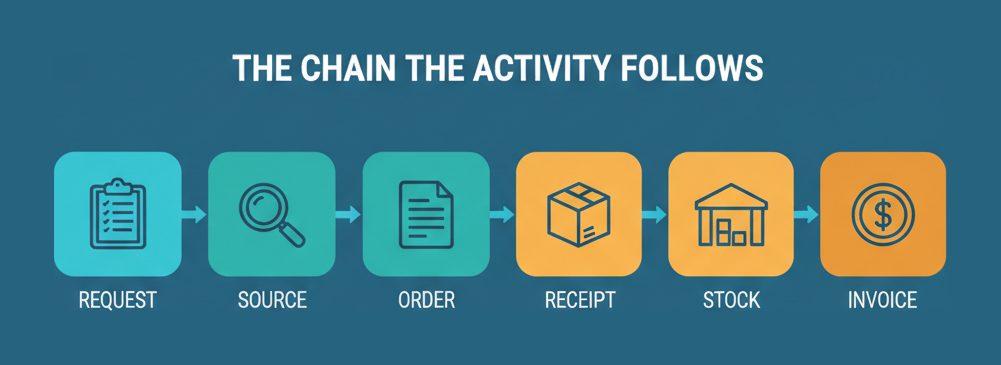
The scope is deliberately end to end rather than narrow. It runs from enterprise structure and procurement master data through the requisition to purchase order to goods receipt to invoice cycle, into sources of supply and source determination, document release strategies, consumption-based planning, inventory management and physical inventory, invoice verification with variances and blocks, and the cross-functional Materials Management customizing that ties those together. SAP applies the same breadth-first reasoning to its newer developer titles, including the C_AIG developer credential.
One detail matters for anyone whose employer has not moved to the cloud private edition. The content applies to on-premise deployments as well, so the configuration skills the credential certifies transfer across both kinds of project. That dual applicability is unusual and it widens the credential’s usefulness considerably. The service module followed the same route, and the C_TS470 exam guide sets out its blueprint areas.
What Changed When C_TS452 Became a System-Based Assessment?
The exam stopped asking whether you recognise the right answer and started asking whether you can produce the right outcome. A System-Based Assessment, or SyBA, presents a single guided activity inside a working SAP system, and you are scored on whether the configuration and transaction tasks were completed correctly. There is no published question count, because there are no questions in the old sense. That shift reaches every S/4HANA line, though the C_S4PM project credential applies it to a credential with no configuration at all.
Three consequences follow directly, and each one changes a habit.
- Partial familiarity earns very little. Knowing that source determination exists but not where its settings live produces an unconfigured system, and the system is what gets marked.
- Navigation speed becomes a scored skill. Time spent hunting for a transaction or a Fiori app is time not spent completing the task.
- Downstream verification matters. Because tasks chain, a step completed incorrectly early can produce visible failures several steps later, and only checking the result catches it.
ERPPrep sets out the format, the cut-score reasoning and the difficulty profile in one place on its C_TS452 exam FAQ, which is worth reading before you plan a study schedule around the old approach.
What Does the C_TS452 Blueprint Cover?
Seven areas, published without weightings, which together describe the whole procure-to-pay flow plus the customizing behind it. They move from organisational structure and master data, through purchasing and sourcing, into planning, inventory and invoice verification, and finish with cross-functional configuration in an implementation context. The same single activity format carries the methodology credential too, and the C_RISME scenario assessment shows how it plays out there.
| Blueprint area | What sits inside it |
|---|---|
| Procurement Processes and Organizational Structure | How purchasing organisation, purchasing group, plant, storage location and company code fit together, and how the cycle flows from requisition through purchase order, goods receipt and invoice, including self-service requisitioning and the stock against consumable material distinction |
| Procurement and Purchasing Master Data | Material master with its purchasing and MRP views, business partner and supplier master, purchasing info records, and the conditions that drive pricing so documents default correctly |
| Purchasing, Sourcing and Source Determination | Info records, contracts and outline agreements as sources of supply, automatic source determination, purchasing optimisation, document release procedures, subcontracting and consignment, and supplier evaluation |
| Consumption-Based Planning and Forecasting | Net requirements and lot-size calculation, scheduling, procurement-proposal and source-of-supply determination, MRP areas, and forecast-based planning |
| Inventory Management and Physical Inventory | Goods receipts, goods issues, stock transfers and transfer postings, reservations, special stock and special procurement, material valuation behaviour, and physical inventory counts with their analyses |
| Invoice Verification | Invoice entry, variances and invoice blocks, subsequent debit and credit, delivery costs and credit memos, automated invoice processing, GR/IR account maintenance, and the customizing controlling tolerance and blocking |
| Cross-Functional Customizing and Implementation Approach | General settings, organizational units, master-data controls, valuation and account assignment, purchasing and inventory settings, navigation across Fiori apps, and the RISE with SAP methodology framing |
Read the seventh area as the one that binds the other six. Cross-functional customizing is where valuation and account assignment decisions made once turn up as consequences everywhere else, which is exactly the kind of chain a task-based assessment is built to test.
Why Is the Cut Score 76 Percent?
Because SAP sets each threshold to the competence it wants certified, and for sourcing and procurement that means reliable capability across the whole flow rather than strength in a few areas. Seventy-six percent sits sixteen points above the 60 percent used by many SAP associate credentials, and the gap is deliberate.
The format reinforces it. On a task-based assessment there is no guessing, and partial familiarity rarely earns partial credit the way an uncertain selection sometimes might on a recall paper. Either the purchase order was released correctly or it was not. That makes a high threshold more achievable for a prepared candidate and considerably less forgiving for an underprepared one.
Practically, treat 76 percent as an instruction to over-prepare rather than as a number to aim at. Candidates who plan for a comfortable margin on a recall exam and carry that expectation into a performance exam are the ones caught out, because the failure mode is not a near miss on knowledge but an incomplete task.
Which Areas Do Candidates Find Hardest?
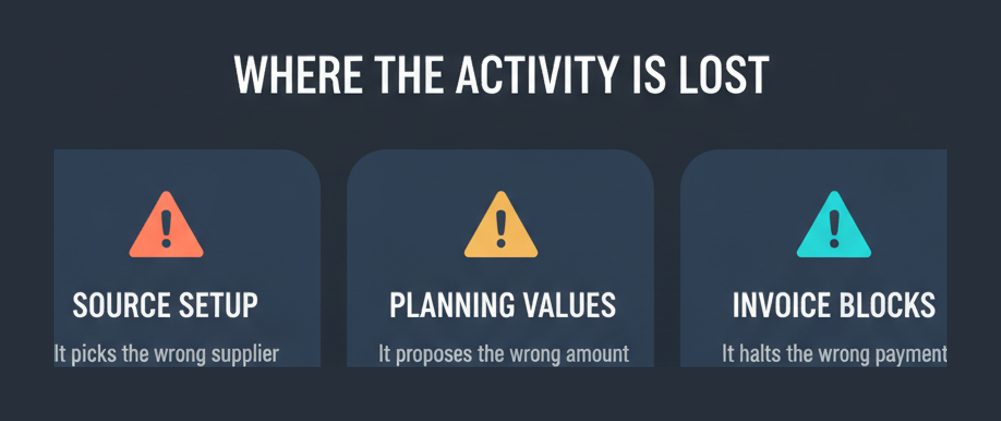
Three consistently: source determination together with document release strategies, consumption-based planning parameters such as lot-size and scheduling behaviour, and invoice-verification variance and blocking logic. What unites them is that a setting configured in one step changes system behaviour several steps downstream.
Source determination and release strategies
These are examined together because they operate together. Info records, contracts and outline agreements feed the source-of-supply logic, and the release procedure then gates the documents that logic produces. A source list or quota arrangement configured early silently shapes which supplier the planning run proposes much later, which is invisible until the wrong proposal appears.
Planning parameters and invoice blocking
Consumption-based planning is unforgiving of small parameter differences: lot-size procedures, scheduling and MRP areas interact, and a modest change produces a different set of procurement proposals. Invoice verification is the mirror image at the end of the chain, where tolerance settings, GR/IR clearing and delivery costs determine whether an invoice blocks, and the correct outcome depends on how the purchase order and goods receipt were set up upstream.
The practical lesson is that none of the three can be rehearsed in isolation. Configuring a release strategy on a system where you did not create the info records teaches half the lesson, and the missing half is the half that gets tested.
What Are the C_TS452 Exam Details?
C_TS452 is an associate-level System-Based Assessment consisting of one activity, passed at 76 percent, published in English, and set against SAP S/4HANA Cloud Private Edition with content that applies to on-premise deployments as well. No question count is published, because the assessment is a single performance task rather than a series of items.
| Detail | Value |
|---|---|
| Exam name | SAP Certified – SAP S/4HANA Cloud Private Edition, Sourcing and Procurement |
| Exam code | C_TS452 |
| Level | Associate |
| Format | System-Based Assessment, one activity |
| Passing score | 76 percent |
| Language | English |
| Product | SAP S/4HANA Cloud Private Edition, applicable to on-premise |
| Blueprint areas | 7 |
| Learning journey | Roughly 90 hours across seven courses |
| Target role | Consultant, mentored project participation |
SAP hosts the seven courses behind the credential in its own sourcing and procurement learning journey, which is the authoritative place to confirm current course content before committing to a schedule.
How Long Does Preparation Actually Take?
Two to three months alongside a job is the realistic range. The learning journey alone runs to roughly 90 hours across seven courses, and a performance-based assessment needs meaningful hands-on repetition on top of that, which is time the course hours do not include.
The range moves with background rather than with effort. A consultant who already configures purchasing and inventory can compress it, because much of the 90 hours is confirming vocabulary for work already done. Someone arriving from a procurement business role without SAP configuration experience should budget the fuller end and add weeks for system time, since the assessment measures execution and execution is only built by executing.
For readers coming to this from the wider module rather than this exam specifically, our S/4HANA sourcing and procurement guide covers how the credential sits against the rest of the materials-management track.
How Should You Prepare for a Single Activity?
Follow the course order the learning journey uses, then convert every course into system time before moving on. The order is not arbitrary: it mirrors how the processes connect, so each later topic reinforces the one before it rather than arriving cold.
- Start with the S4500 overview course to build the end-to-end procurement picture, because every later area assumes you already know where it sits in the procure-to-pay flow.
- Work S4520 next for purchasing, covering master data, sources of supply, source determination, release procedures and supplier evaluation, and configure each one yourself rather than reading about it.
- Take S45250 for consumption-based planning as its own study block, practising how lot-size procedures, scheduling and MRP areas interact, since small parameter differences change the proposals the system generates.
- Move to S4510 for inventory management and physical inventory, posting goods receipts, issues, transfer postings and reservations so the valuation and account-assignment impact of each becomes familiar.
- Complete S4515 for invoice verification, working variance and blocking scenarios end to end so that tolerance settings, GR/IR clearing and delivery costs are understood as consequences of upstream configuration.
- Finish with S4550 for cross-functional customizing and SL_RISE419 for implementation methodology, then rehearse full procure-to-pay chains under time pressure until the sequences run without hesitation.
ERPPrep’s own preparation material is built around this shape, with scenario simulations and skill drills that rehearse the task sequences rather than the terminology, which is the right register for a performance assessment.
Which Version Code Is Current
The unsuffixed C_TS452 is the current code. Several year-suffixed variants remain in circulation and are still searched for, which is a reliable sign that candidates are working from older material, and the differences between them are not cosmetic when the assessment format itself has changed.
SAP’s own certification browser is the authoritative place to confirm which version is live before booking, and it is worth checking rather than assuming, because study material written for an earlier suffix describes a different kind of exam entirely.
Anyone who prepared for the earlier version will find the scope familiar and the method obsolete. Our guide to the C_TS452_2022 certification journey remains a useful map of the subject matter, and reading it alongside this article makes the size of the format shift clear.
What the Credential Does for a Procurement Career
It certifies the transition from using SAP procurement to configuring it. The credential targets a consultant profile at mentored project depth, which is the point where a materials-management specialist stops raising purchase orders and starts deciding how purchase orders behave for everyone else.
That distinction is also where the compensation difference sits. Independent salary data for the SAP consultant role reflects the configuration side of the boundary rather than the transactional side, and a performance-based credential is unusually good evidence that you belong on it.
For readers new to the discipline itself rather than to SAP, a general grounding in the procure-to-pay process is worth having before the courses, since the blueprint assumes the business flow is already understood and teaches only how S/4HANA implements it.
Frequently Asked Questions
What is the SAP C_TS452 exam format?
A System-Based Assessment consisting of one hands-on activity. You carry out configuration and transaction tasks inside a working SAP system, and scoring reflects whether those tasks were completed correctly rather than whether statements were recognised.
What is the passing score for C_TS452?
Seventy-six percent, which is sixteen points above the 60 percent threshold many SAP associate credentials use. The higher bar reflects an expectation of reliable capability across the whole sourcing and procurement scope.
How many activities does the C_TS452 exam include?
One. It is delivered as a single guided activity in a configured system rather than as a series of separate items, so preparation should build sustained multi-step execution rather than rapid recall.
What does the SAP sourcing and procurement certification cover?
Seven blueprint areas: procurement processes and organisational structure, master data, purchasing and source determination, consumption-based planning, inventory management and physical inventory, invoice verification, and cross-functional customizing.
Is C_TS452 available in languages other than English?
The published language is English. Because the assessment requires reading task instructions and acting on them in a system under time pressure, comfort with English procurement terminology makes a material difference to pace.
How long should I prepare for C_TS452?
Two to three months alongside a job. The learning journey runs roughly 90 hours across seven courses, and the performance-based format needs additional hands-on repetition beyond the course time itself.
Do I need system access to prepare for C_TS452?
Effectively yes. The assessment requires completing real configuration and transaction tasks, and only working in a system builds the speed and accuracy the single activity demands. Scenario simulation is the next-best substitute.
Which C_TS452 topics are hardest?
Source determination with document release strategies, consumption-based planning parameters such as lot-size and scheduling, and invoice-verification variance and blocking. All three involve settings whose effects appear several steps downstream.
Does C_TS452 apply to on-premise SAP S/4HANA?
Yes. The certification targets SAP S/4HANA Cloud Private Edition, and the content applies to on-premise deployments as well, so the configuration skills transfer across both kinds of implementation project.
Can I take C_TS452 without prior SAP experience?
Yes, though it takes longer. The credential assumes entry-level mentored project participation rather than years of expertise, so newcomers should follow the full course order and pair every topic with system time.
Conclusion
The SAP sourcing and procurement certification now measures what you can do rather than what you can recognise. One System-Based Assessment activity, a 76 percent cut score sixteen points above the associate norm, seven blueprint areas covering the whole procure-to-pay flow, and no question count to plan around because there are no questions to count.
Work the courses in the order the learning journey sets out, convert each one into system time before moving to the next, and give source determination, planning parameters and invoice blocking the extra rehearsal their downstream effects deserve. Confirm the current version code before booking, and treat hands-on repetition as the preparation rather than as the revision.


