It is easy to assume that the two best known SAP supply chain certifications are two halves of one exam with the same rules. They are not. C_IBP, for planning in SAP Integrated Business Planning, is a 3 hour System-Based Assessment with a 90 percent pass score. C_S4TM, for Transportation Management in SAP S/4HANA, is a 2 hour Scenario-Based Assessment with a 60 percent pass score.
The difference in rules follows a difference in work. A C_IBP consultant decides how much to make, stock and ship, and when. A C_S4TM consultant decides how the goods actually travel, on which route, with which carrier and at what charge. Both are associate credentials, both draw their attempts from an SAP Learning Hub subscription, and neither is a prerequisite for the other. This comparison sets the two SAP supply chain certification options side by side, shows what each exam asks you to do, explains where the plan meets the freight, and ends with an order for taking one or both.
How Do C_IBP and C_S4TM Compare Side by Side?
C_IBP and C_S4TM are both associate credentials for consultants, and SAP calls each an entry-level qualification for project work under an experienced consultant. Everything else differs: the system, the exam format, the clock and the pass score. C_IBP runs for 3 hours at 90 percent; C_S4TM runs for 2 hours at 60 percent.
| Factor | C_IBP (plan) | C_S4TM (execute) |
|---|---|---|
| Official title | SAP Certified – SAP Integrated Business Planning | SAP Certified – SAP S/4HANA Cloud Private Edition, Transportation Management |
| Level | Associate | Associate |
| Role SAP lists | Consultant | Consultant |
| Where the work happens | SAP Integrated Business Planning, a cloud planning solution | Transportation Management in SAP S/4HANA, relevant for Cloud Private Edition and on-premise |
| Format | System-Based Assessment, 1 activity | Scenario-Based Assessment, 1 activity |
| Duration | 3 hours | 2 hours |
| Pass score | 90 percent | 60 percent |
| Languages | English | Roleplay with AI guidance: English, Spanish, Italian, French, Japanese and more; record a video: English only |
| Weighted exam topics | Three: Demand, Configuration, Supply | None displayed by SAP |
| SAP learning journey | Implementing SAP Integrated Business Planning | Implementing Transportation Management in SAP S/4HANA Cloud |
Neither SAP page shows an exam fee or a question count. Attempts come from a Learning Hub subscription, and each exam is one activity rather than a list of items, so the figures worth planning around are the clock, the pass score and, for C_IBP, the topic weights.
What Does C_IBP Ask a Supply Chain Planner to Do?
C_IBP asks you to work as a supply chain planning consultant inside a live SAP Integrated Business Planning system. It is one System-Based Assessment activity of 3 hours, in English, and SAP sets the pass score at 90 percent, so the exam checks that you can do the planning tasks correctly, not that you can describe them.
The scope covers the whole planning side of the chain: statistical forecasts and demand sensing, inventory planning, sales and operations planning, response and supply planning in both time-series and order-based modes, the Supply Chain Control Tower, and the planning model underneath, with its planning areas, time profiles and key figures. The C_IBP study guide on ERPPrep breaks this into seven blueprint areas. SAP weights the exam by three topics:
| C_IBP exam topic displayed by SAP | Weight |
|---|---|
| Demand | 54 percent |
| Configuration | 21 to 30 percent |
| Supply | 21 to 30 percent |
Demand alone carries more than half of the weight, which tells you what a planner on this exam spends most of the activity on. SAP lists the skills as systems architecture, analytics, reporting tools, supply chain planning, business process and user acceptance testing, and points to a practice system inside the learning journey.
What Does C_S4TM Ask a Transportation Consultant to Do?
C_S4TM is a 2 hour Scenario-Based Assessment on Transportation Management in SAP S/4HANA, with a 60 percent pass score. It asks you to reason through a realistic transportation situation as a consultant would: which network, freight units, planning settings, carriers and charges fit the case, and why. SAP says it is relevant for SAP S/4HANA Cloud Private Edition and on-premise.
The content follows one shipment from setup to invoice. ERPPrep’s blueprint for C_S4TM covers master data and organizational structures, the transportation network of locations, zones and lanes, freight units created from orders and deliveries, interactive and automatic planning in the transportation cockpit, carrier selection and tendering, execution with warehouse integration and track and trace, and freight charges with settlement and carrier invoice verification.
SAP displays no weighted exam topics for C_S4TM, so plan your study across all of these areas rather than around a single heavy one. The format sets this exam apart: the languages vary by format. With roleplay with AI guidance, SAP lists English, Spanish, Italian, French, Japanese and more; if you record a video instead, the exam is English only. SAP also offers an AI-powered scenario-based assessment tool to try out before the exam.
Plan or Execute: How Different Is the Work?
The two roles sit at opposite ends of the same chain. A planner behind C_IBP works with weeks and months: forecasts, stock targets and supply plans that balance demand against capacity. A transportation consultant behind C_S4TM works with days and shipments: freight orders, routes, carriers and charges for goods that have to move now.
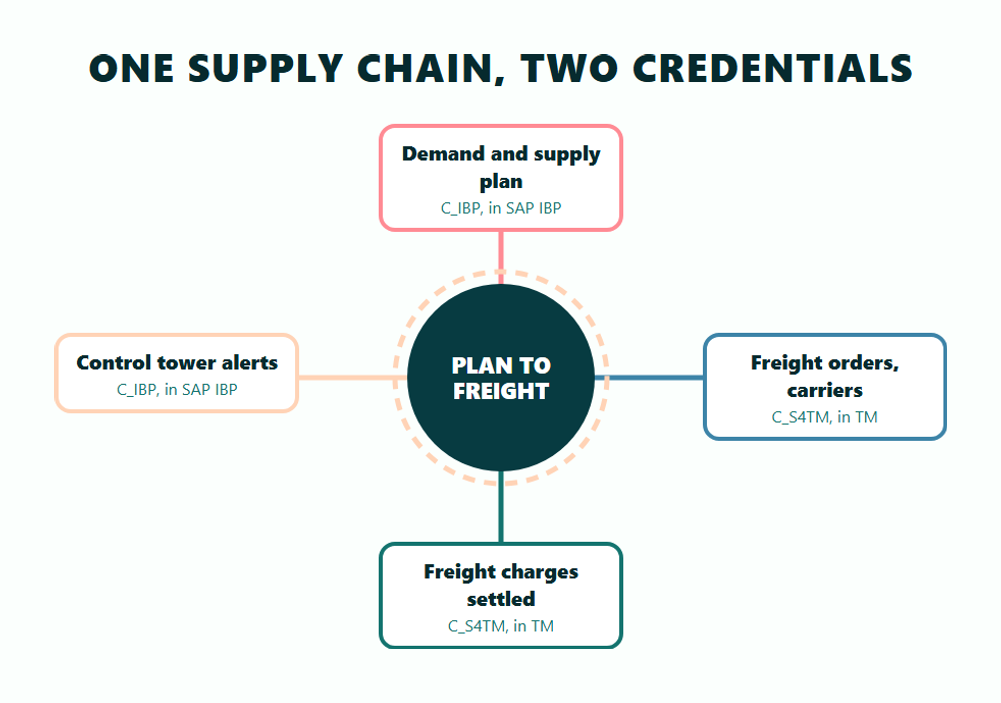
On the planning side, a typical task is a forecast that missed: the consultant checks the statistical model, adjusts it with business input, and sees how the change ripples into the supply plan and the alerts in the Control Tower. The work runs through the IBP web UI and the Microsoft Excel add-in, and much of it supports the monthly sales and operations planning cycle that brings demand and supply teams to one number.
On the transportation side, a typical task is a shipment that does not plan: the consultant checks whether the lane exists, whether the freight unit was built from the delivery, whether a carrier is valid for the route, and how the charge will be calculated and settled. The work runs through the transportation cockpit and freight documents in SAP S/4HANA.
The question behind “best SAP certification for supply chain management” is usually this one: do you want to decide what the business should do next quarter, or make sure that what it promised today actually arrives?
Where Does an IBP Plan Meet TM Execution?
The plan from SAP IBP and the freight in SAP S/4HANA Transportation Management meet through the orders and deliveries that execution creates. In the C_IBP blueprint the planner balances supply against demand, including order-based planning tied to real customer orders; in the C_S4TM blueprint the consultant turns orders and deliveries into freight units and plans them.
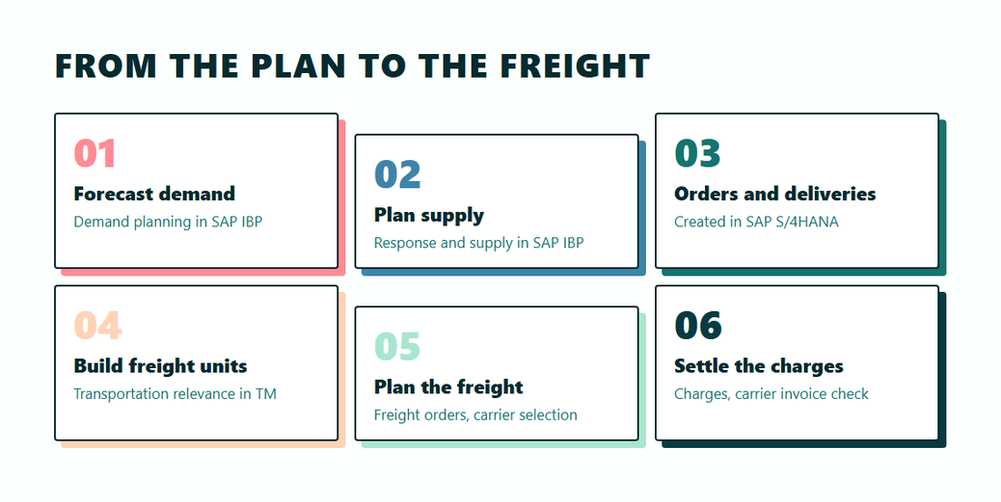
Read together, the two blueprints describe one flow seen from two desks:
- The planner forecasts demand in SAP IBP and refines it with business input.
- The planner balances supply against that demand, so the plan respects inventory, lead times and capacity.
- Orders and deliveries in SAP S/4HANA carry the plan into execution.
- The transportation consultant builds freight units from orders and deliveries that are relevant for transportation.
- The transportation consultant plans the freight, selects carriers and produces freight orders.
- Charges are calculated, settled and checked against the carrier invoice.
This is why the two credentials work well in one supply chain team. A planner who knows how freight is planned sets lead times that execution can actually meet, and a transportation consultant who understands the plan knows which shipments the business has already promised.
Which SAP Supply Chain Certification Fits You?
Choose the end of the chain you want to work in every day. C_IBP fits people who enjoy forecasts, data and planning models, and who are comfortable with a 90 percent bar. C_S4TM fits people who enjoy logistics, networks and carriers, and who prefer reasoning through a case. Both certify an associate consultant in a mentored project role.
Signs that planning, and C_IBP, fits you
- You come from demand planning, supply planning or sales and operations planning.
- You like spreadsheets, statistics and asking why a forecast moved.
- You would rather shape next quarter’s plan than chase today’s shipment.
Signs that transportation, and C_S4TM, fits you
- You come from logistics, shipping, freight procurement or a carrier.
- You think in lanes, routes, loads and charges.
- You want to configure how goods move in SAP S/4HANA, from planning a load to settling the invoice.
If you are still unsure, compare the exam formats once more. C_IBP is hands-on work in a live system, with demand at 54 percent of the weight. C_S4TM is a scenario you reason through and defend. For a closer look at the planning exam on its own, see our SAP IBP modules guide.
Should You Take Both, and in Which Order?
Neither SAP page lists the other exam as a prerequisite, and both sit at associate level, so there is no official order between C_IBP and C_S4TM. Take first the exam for the end of the chain you work in now. Adding the second makes sense for consultants whose projects cover both planning and logistics execution.
A planner who adds C_S4TM learns what transportation can and cannot do in a given week, which makes supply plans more realistic. A transportation consultant who adds C_IBP learns where the orders come from and why their timing matters. Neither move is required, and SAP does not describe one as a step toward the other.
Plan for the very different rules. C_IBP asks for 90 percent across a 3 hour hands-on activity, which leaves almost no room for a weak area, and demand planning alone carries 54 percent. C_S4TM asks for 60 percent in 2 hours, but it is a scenario with no published topic weights, so a gap anywhere in the flow from network to settlement can cost you.
How Should You Prepare for Each Exam?
Prepare for the format first, because C_IBP is a System-Based Assessment and C_S4TM a Scenario-Based Assessment. Both SAP pages point to a Technical Readiness Checklist and a Learning Hub subscription with an SAP Universal ID that holds the exam attempts. After that, the routes split.
Preparing for C_IBP
The SAP IBP certification page recommends the learning journey Implementing SAP Integrated Business Planning, which contains the practice system. Work the planning cycle end to end in that system, then give demand planning the most hours, matching its 54 percent weight. Configuration and supply each carry 21 to 30 percent, so do not skip the planning model.
Preparing for C_S4TM
The Transportation Management certification page recommends the journey Implementing TM in S/4HANA Cloud, which covers planning, execution and charges. Practice explaining each decision out loud, since the scenario asks you to reason, and try SAP’s scenario-based assessment tool. Our lane to invoice walkthrough follows one shipment through the whole flow.
Frequently Asked Questions
Which is the best SAP supply chain certification?
There is no single best one. C_IBP fits planning work in SAP Integrated Business Planning, and C_S4TM fits transportation work in SAP S/4HANA. Choose the credential for the end of the supply chain you want to work in.
What is the difference between C_IBP and C_S4TM?
C_IBP certifies supply chain planning: demand, supply and the planning model in SAP IBP. C_S4TM certifies transportation execution: networks, freight units, freight planning, carriers and freight charges in SAP S/4HANA.
What pass score do C_IBP and C_S4TM need?
SAP displays a 90 percent pass score for C_IBP and a 60 percent pass score for C_S4TM on their certification pages.
How long are the C_IBP and C_S4TM exams?
SAP shows a duration of 3 hours for C_IBP and 2 hours for C_S4TM. Each is a single activity.
Is C_IBP a System-Based or Scenario-Based Assessment?
C_IBP is a System-Based Assessment, in which you carry out tasks in a live system. C_S4TM is a Scenario-Based Assessment, in which you reason through a realistic business situation.
In which languages can I take C_S4TM?
SAP says the languages vary by format: roleplay with AI guidance is offered in English, Spanish, Italian, French, Japanese and more, while recording a video is English only. C_IBP is available in English.
Is C_IBP a prerequisite for C_S4TM, or the other way around?
No. Neither certification page lists the other exam as a prerequisite, and both are associate level credentials you can take in either order.
Which part of the C_IBP exam carries the most weight?
Demand carries 54 percent of C_IBP, according to SAP. Configuration and supply each carry 21 to 30 percent.
Does C_S4TM cover warehouse management too?
Only where transportation touches it: the C_S4TM blueprint includes warehouse integration during execution. Warehouse management in SAP S/4HANA has its own separate credential.
Conclusion
The SAP supply chain certification choice between C_IBP and C_S4TM is a choice between planning and execution. C_IBP proves you can plan demand and supply in SAP Integrated Business Planning, in a 3 hour System-Based Assessment with a 90 percent pass score and demand at 54 percent of the weight. C_S4TM proves you can run transportation in SAP S/4HANA, in a 2 hour Scenario-Based Assessment with a 60 percent pass score. Pick the end of the chain whose work you want to do, prepare for its format, and add the other credential only when your projects start to span both.


