Search for the SAP Hybris business analyst certification today and you end up on C_C4H32. Hybris became SAP Commerce Cloud years ago, and the credential for the people who run its storefront, catalogs and promotions now carries the full title SAP Certified – Business User – SAP Commerce Cloud.
The SAP Commerce Cloud business user certification is not a developer exam. SAP describes it as proof of the core skills of an SAP Commerce Cloud business analyst who can work in a mentored project team role, and it delivers the exam as one hands-on System-Based Assessment activity with a 3 hour duration and a 60 percent pass score. This article explains how the exam runs, the six weighted topics SAP lists, the business roles it assumes you can play, how product content, web content, search, promotions and B2B fit together, how to prepare, and when the developer exam is the better choice.
How Does SAP Run the C_C4H32 Exam?
SAP runs C_C4H32 as a single System-Based Assessment activity. You log in to a working SAP Commerce Cloud environment and carry out business-user tasks, such as maintaining products, editing storefront content or setting up a promotion, and the result depends on whether the work is done correctly. SAP displays a 3 hour duration and a 60 percent pass score.
A System-Based Assessment is one of the two performance-based formats SAP now uses for its certifications. Instead of recognising correct statements, you act inside the system the way a business user would on a project. The exam rewards people who have clicked through the cockpits often enough that the steps feel routine, and it exposes anyone who has only read about them.
| Field | ERPPrep study guide | SAP certification page |
|---|---|---|
| Exam code | C_C4H32 | C_C4H32 |
| Level | Associate | Recommended for entry-level qualifications |
| Format | System-Based Assessment, 1 activity | 1 activity, System Based Assessment |
| Pass score | 60% | 60% |
| Duration | Not published | 3 hours |
| Languages | English | Available in English |
| Learning journey | Configuring SAP Commerce Cloud | Configuring SAP Commerce Cloud |
The sources agree on every field they both publish. ERPPrep gives no duration, while the official SAP certification page displays 3 hours, so that is the figure to plan around. Neither source publishes a separate exam fee, because attempts come with an SAP Learning Hub subscription, so no price is given here.
ERPPrep builds its C_C4H32 scenario simulations around that format, with full multi-phase scenarios and skill drills grouped into twelve skill domains. Those domains are a finer practice grouping of the same material, not a different syllabus.
What SAP asks you to check before exam day
The certification page lists three readiness steps. Run the technical readiness checklist for hardware, software and connectivity. Confirm a Learning Hub subscription that includes certification exam attempts and an SAP Universal ID with a secondary email set up. Then watch SAP’s introduction to system-based assessments and use the practice system inside the learning journey, so the environment is familiar before an attempt counts. SAP also notes that access requires SAP customer or partner registration.
Which Six Topics Carry the Weight on C_C4H32?
SAP lists six exam topics for C_C4H32, each with a weight range. Product Content Management and Commerce are the two heaviest at 21 to 30 percent each. Web Content Management, Order Management and Customer Support, B2B Commerce and Essential Foundation each carry 11 to 20 percent. Together they describe what a business user does every day on an SAP Commerce Cloud storefront.
| SAP exam topic | Weight | What to expect |
|---|---|---|
| Product Content Management | 21-30% | Products, categories, classification attributes, prices, media, variants and bundles in the Backoffice Product Cockpit |
| Commerce | 21-30% | The selling side of the storefront as SAP groups it under one label |
| Web Content Management | 11-20% | The WCMS page model, SmartEdit editing, synchronisation and personalisation |
| Order Management and Customer Support | 11-20% | Order workflow, sourcing and availability, cancellations, returns, ticketing and assisted service |
| B2B Commerce | 11-20% | Merchant and buyer organisations, budgets, quotes, approvals and PunchOut |
| Essential Foundation | 11-20% | Purpose and components of SAP Commerce Cloud, user roles and Backoffice administration basics |
SAP’s page shows the topic names and weights only. The descriptions in the third column come from the learning journey courses and ERPPrep’s blueprint, matched to the closest SAP label.
How ERPPrep’s seven areas map onto SAP’s six topics
ERPPrep’s study guide splits the same material into seven blueprint areas without weightings: SAP Commerce Cloud fundamentals and user roles; product content management in the Backoffice Product Cockpit; web content management and SmartEdit; Backoffice administration; search, promotions and coupons; B2B commerce and order fulfillment; and AI-driven merchandising and automation. SAP’s list has no topic named after search, promotions or AI merchandising, yet the learning journey gives each of them a dedicated course. Treat them as examinable material even though no SAP label carries their name, and use SAP’s weights to decide where the bulk of your hours go.
Is C_C4H32 the Old Hybris Business Analyst Certification?
In practice, yes. SAP Commerce Cloud is the product that used to be called SAP Hybris, so the business analyst credential people still search for under the Hybris name is today’s C_C4H32. The exam itself is new in format: it is a System-Based Assessment on the current cloud product, not the knowledge exam of the Hybris era.
The history explains why both names keep appearing in job adverts and study material. Hybris was founded in Munich in 1997, SAP acquired it in August 2013, and in 2018 the platform was folded into SAP’s Customer Experience portfolio and renamed SAP Commerce Cloud, as the SAP Hybris history records. Older Hybris tutorials can still explain the concepts, but the exam tests the current cloud product.
The code has changed too. Search data still shows people looking for C_C4H32_2411, a dated version of the code. SAP’s certification page now lists the credential simply as C_C4H32, so that is the code to book and the one this article describes.
Which Business User Roles Does the Exam Expect You to Play?
C_C4H32 assumes you can switch between the business roles that run an SAP Commerce Cloud site. ERPPrep names the product manager, web content manager, search manager, marketing manager, administrator and customer support agent. Each role works in its own cockpit, and a scenario usually tells you which role you are playing only through the task it sets.
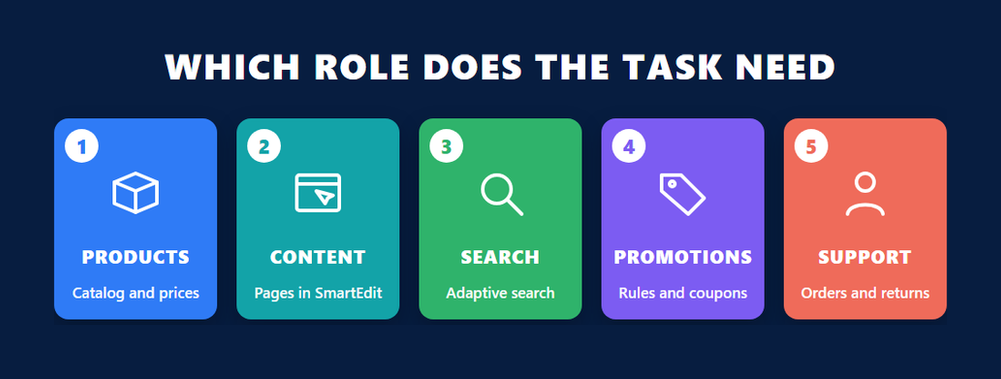
That is why the first SAP topic, Essential Foundation, matters more than its weight suggests. If you cannot tell from a task description that it belongs to the product manager in the Backoffice Product Cockpit rather than the web content manager in SmartEdit, you lose time in the wrong tool. SAP’s own role tags on the certification page say the same thing in shorter form: business user, consultant, product management, online store, content management, business process, system administration and web content management.
- Product manager: maintains products, categories, attributes, prices, media, variants and bundles.
- Web content manager: builds and synchronises storefront pages and components in SmartEdit.
- Search manager: configures the Search Service and adaptive search.
- Marketing manager: sets up promotions, coupons and merchandising carousels.
- Administrator: manages users, access rights, validation, workflows and cronjobs in the Backoffice Administration Cockpit.
- Customer support agent: handles orders, returns, tickets and assisted service.
How Do the Product Cockpit and SmartEdit Divide the Work?
The Backoffice Product Cockpit holds what you sell and SmartEdit controls how the storefront shows it. Product Content Management, weighted 21 to 30 percent, covers product data in the cockpit. Web Content Management, weighted 11 to 20 percent, covers pages, components and personalisation in SmartEdit. Together they make up the largest single block of the exam.
Product content in the Backoffice Product Cockpit
The product manager course, C4H322B, covers editing and searching for products, organising category hierarchies, importing and enriching products in bulk, adding attributes through the classification system, assigning prices, managing media assets, and configuring variant products and bundles for cross-selling and upselling. Each of these behaves differently, and a system-based task can ask for any of them as a concrete change you have to make and save correctly.
Web content in SmartEdit
The web content course, C4H323B, starts with the WCMS page model and content architecture, then moves into SmartEdit: creating and synchronising content, versioning, working with shared components and slots in advanced edit mode, managing navigation, and applying personalisation through restrictions and customisation. Synchronisation is the step people forget, so rehearse the full path from an edit to a page shoppers can actually see.
Where Do Search, Promotions and AI Merchandising Fit?
Search, promotions and AI merchandising are the marketing and search manager side of C_C4H32. They have no topic of their own in SAP’s six labels, but the learning journey teaches each in a dedicated course, and ERPPrep gives them two of its seven blueprint areas, so expect them inside the heavier Commerce weighting.
Search work, taught in C4H382B, means connecting and configuring the cloud Search Service, setting up search in Backoffice, configuring adaptive search, and applying AI-driven intelligent search for a more personal result list. Promotions work, taught in C4H327B, means building standard and targeted promotions with conditions, actions, priorities and rule groups, creating single-code and multi-code coupons, and deciding how potential promotions are shown to customers.
Two newer courses cover the AI features. C4H380B introduces personalised product recommendations with Intelligent Selling Services, including merchandising carousels with A/B testing and reporting. C4H381B covers the SAP CX AI Toolkit, used to enrich product data and descriptions, simplify product discovery, work with product images and generate personalised content. Give them their own practice time rather than assuming search and promotions cover them.
What Does B2B Commerce Add to the Storefront Picture?
B2B Commerce, weighted 11 to 20 percent, adds the business buyer to a storefront built for consumers. You set up merchant and buyer organisations, purchasing thresholds, cost centers and budgets, handle quote negotiation and order approval, and connect buyers’ procurement systems through PunchOut. Order Management and Customer Support, another 11 to 20 percent, then covers what happens after the order.
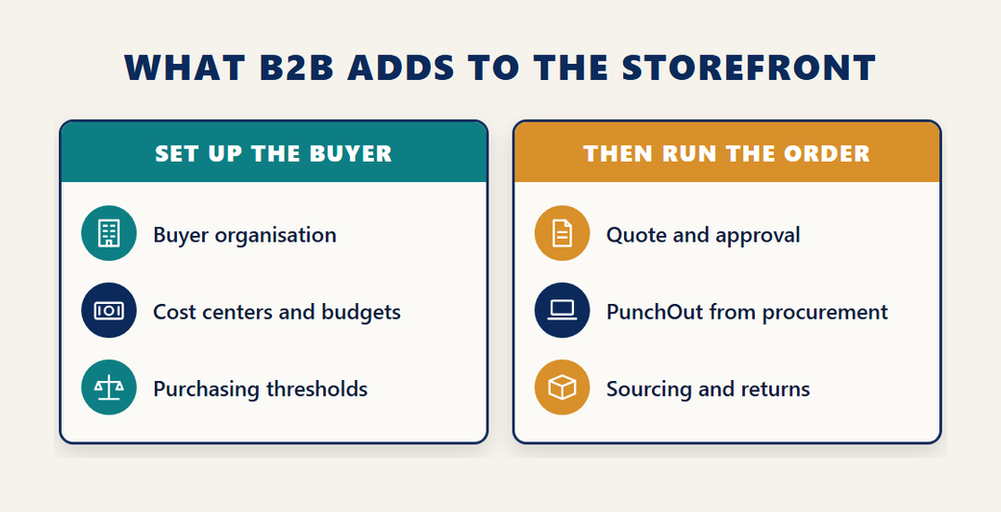
The B2B course, C4H324B, works through the merchant sales organisation and its purchasing thresholds, the buyer organisation with its cost centers and budgets, ordering options, quote negotiation and approvals. PunchOut is the piece that links commerce to procurement: a buyer leaves their own purchasing system, shops the supplier’s catalog, and the cart travels back for approval. The pattern comes from the cXML PunchOut protocol, widely used in B2B procurement.
After the order is placed
The order and support course, C4H326B, covers the standard order management workflow and its interfaces, basic configuration with sourcing and ATP formulas, processing, versioning, cancelling and returning orders, ticketing, and assisted service mode, where an agent acts on a customer’s behalf. Practise these as one chain: a B2B order that waits for approval, is sourced, partly cancelled and later returned touches most of what this topic asks.
How Should You Prepare for a Three Hour System-Based Assessment?
Prepare for C_C4H32 by doing the tasks, not by reading about them. Work through the Configuring SAP Commerce Cloud learning journey with its practice system open, follow the business roles in order, and repeat each cockpit task until you can complete it without notes. Three hours is enough time only if the steps are already routine.
- Learn the business-user roles as a connected set, so you can tell which cockpit and task a scenario is really asking about.
- Practise product management hands-on in the Backoffice Product Cockpit, covering editing, category hierarchies, bulk import, classification attributes, pricing, media and variants.
- Rehearse web content in SmartEdit end to end, from the WCMS page model to synchronisation, shared components and personalisation.
- Treat search and promotions as their own study block, configuring the Search Service and adaptive search, then building promotions and coupons with conditions, priorities and rule groups.
- Work through B2B setup and order support as full chains, from merchant and buyer organisations through approvals to order management and assisted service.
Spend the most hours on the two 21 to 30 percent topics, Product Content Management and Commerce, but do not skip the smaller ones: a single system activity can touch several topics in one task. Keep the SAP Commerce Cloud product documentation on the SAP Help Portal nearby while you practise, since SAP names it as preparation material alongside the Configuring SAP Commerce Cloud journey.
ERPQnA’s earlier business user preparation guide is a useful second pass once the hands-on work is done. Check any older figures in it against SAP’s current certification page, since the exam format has changed.
Business User or Developer: Which SAP Commerce Cloud Exam Fits You?
Choose C_C4H32 if you run the storefront: products, content, search, promotions, B2B buyers and orders. Choose the developer credential, P_C4H34, SAP Certified – Developer – SAP Commerce Cloud, if you extend and customise the platform in code. ERPPrep lists P_C4H34 at Professional level and C_C4H32 at Associate level, and both are system-based.
| Question | C_C4H32 business user | P_C4H34 developer |
|---|---|---|
| Who it fits | Business analysts, product and content managers, functional consultants new to a commerce project | Developers who build on and customise the platform |
| Level | Associate | Professional |
| Main tools | Backoffice cockpits and SmartEdit | The platform’s code and extension model |
| Format | System-Based Assessment | System-Based |
For most functional people the business user exam is the right first step, because it maps directly to the work on a commerce project’s business side. A consultant who later moves into technical work can add the developer credential. For a second view of the business user study material, see ERPQnA’s page on the business user study materials.
Frequently Asked Questions
What is C_C4H32?
C_C4H32 is the exam code for SAP Certified – Business User – SAP Commerce Cloud. It confirms the core skills of an SAP Commerce Cloud business analyst who can work in a mentored project team role.
How is the C_C4H32 exam delivered?
As one System-Based Assessment activity. You carry out business-user tasks in a working SAP Commerce Cloud environment, and SAP’s certification page displays a 3 hour duration.
What is the pass score for C_C4H32?
Both SAP and ERPPrep give the pass score as 60 percent.
Does C_C4H32 still use a question bank?
No. The exam is performance-based, so there is no bank of separate items to memorise. You are scored on whether the tasks in the system activity are completed correctly.
Which topics carry the most weight?
Product Content Management and Commerce, at 21 to 30 percent each. Web Content Management, Order Management and Customer Support, B2B Commerce and Essential Foundation each carry 11 to 20 percent.
Is C_C4H32 the same as the SAP Hybris business analyst certification?
It is the current credential for that role. SAP Hybris was renamed SAP Commerce Cloud in 2018, and C_C4H32 tests business-user work on today’s cloud product in the system-based format.
What happened to C_C4H32_2411?
That is a dated version of the code. SAP’s certification page now lists the credential as C_C4H32, which is the code to book.
In which language can I take C_C4H32?
SAP’s certification page shows the exam as available in English, and ERPPrep lists English as well.
Should I take the developer exam instead?
Only if you customise the platform in code. P_C4H34 is the Professional level developer credential; C_C4H32 is the Associate level exam for the people who run the storefront.
Conclusion
The SAP Commerce Cloud business user certification is the modern form of the Hybris business analyst credential: one System-Based Assessment activity, 3 hours, a 60 percent pass score, and six weighted topics led by Product Content Management and Commerce. It rewards people who can move between the Backoffice Product Cockpit, SmartEdit, search, promotions, B2B setup and order support without hesitating over which tool a task needs. Build that fluency in the learning journey’s practice system, weight your hours by SAP’s topic ranges, and keep the help portal open while you work. When the cockpit steps feel routine, run full scenarios end to end and book the exam.


