No system opens when C_BCFIN begins. There is nothing to configure, no document to post and no master record to maintain. The single activity is a customer situation, and the whole result depends on what you say to a finance leader about it. That makes SAP Certified – Positioning SAP Business Suite via SAP Financial Management Solutions an unusual SAP exam, and an easy one to prepare for in the wrong way.
This article walks through positioning SAP Financial Management solutions the way the exam expects: who the credential is for, how the Scenario-Based Assessment is scored, the seven blueprint areas on ERPPrep’s study guide, what the CFO persona and buying centers mean in a real conversation, how AI, data and sustainability join the finance story, how RISE with SAP and GROW with SAP differ as transformation paths, and a preparation order built around the four courses in the learning journey.
Table of Contents
- What does C_BCFIN certify, and who is it written for?
- How is the C_BCFIN Scenario-Based Assessment delivered and scored?
- Which seven blueprint areas does the C_BCFIN study guide cover?
- What does the CFO actually want to hear?
- How do you position end-to-end finance processes without reciting features?
- Where do SAP Business AI, Business Data Cloud and Sustainability enter the finance story?
- RISE with SAP or GROW with SAP: which path fits the scenario?
- How should you prepare for C_BCFIN?
- How does C_BCFIN compare with C_BCSBS, C_BCBTP and C_TS4FI?
- Frequently Asked Questions
- Conclusion
What does C_BCFIN certify, and who is it written for?
C_BCFIN certifies that you can position SAP Financial Management solutions within the SAP Business Suite for a presales or sales audience, at Associate level, without configuring anything. ERPPrep’s study guide describes the audience as presales and sales professionals, plus customer-facing SAP practitioners moving into a financial management positioning role, who want a recognized credential for articulating finance value to a Chief Financial Officer.
Positioning, not implementation
Most SAP associate exams check whether you can make a system do something. This one checks whether you can explain why a finance organization should want it. The credential name says so twice: it is about positioning the SAP Business Suite, and it does so through the finance portfolio. ERPPrep’s FAQ page is explicit that no hands-on system access is needed to prepare, because the assessment measures positioning judgment rather than technical execution in a live environment.
That distinction decides how you should study. A consultant preparing for a Financial Accounting implementation exam rehearses postings and period-end steps. A candidate preparing for C_BCFIN rehearses conversations: what a finance leader said, which process it points to, which value driver answers it, and how AI, data and the cloud path strengthen the case.
The three things the credential proves
ERPPrep’s study guide summarizes the scope as three abilities. First, identifying the end-to-end finance processes SAP Financial Management supports inside the suite. Second, articulating the business value drivers and the customer value proposition that resonate with a CFO. Third, recognizing the market trends shaping SAP’s finance strategy. Around those sit the integration story with SAP Business Data Cloud, SAP Business AI and SAP Sustainability, and the cloud transformation framing through RISE with SAP and GROW with SAP.
Entry-level depth is stated plainly. The exam does not expect you to have sold SAP for a decade; it expects you to reason from a customer’s finance priorities to a value-led response, consistently, across a realistic situation.
How is the C_BCFIN Scenario-Based Assessment delivered and scored?
C_BCFIN is delivered as one Scenario-Based Assessment activity and passed at 60 percent, the figures ERPPrep publishes on its study guide, FAQ and product pages. SAP’s own certification page for the exam sits behind a login, so it publishes no duration and no language list to the public, and ERPPrep lists the languages as not published by SAP. No question count exists, because there is no item bank.
| Field | Value |
|---|---|
| Exam code | C_BCFIN |
| Credential | SAP Certified – Positioning SAP Business Suite via SAP Financial Management Solutions |
| Level | Associate |
| Format | Scenario-Based Assessment (SBA), 1 activity |
| Passing score | 60 percent |
| Duration | Not published on any public page; SAP’s certification page requires a login |
| Languages | Not published by SAP, as ERPPrep records it |
| Product | SAP Financial Management |
| Blueprint areas | Seven on the study guide, with no published weightings |
| Earlier release | C_BCFIN_2502, the suffixed code older guides still describe |
What one activity means for you
A Scenario-Based Assessment gives you a realistic customer situation and asks you to apply judgment to it. In this exam that means reading a finance leader’s priorities, choosing the value message that fits them, and connecting that message to the right solutions, the right supporting layers and the right transformation path. ERPPrep’s FAQ describes the result as a chain, where a mismatched message early on undermines everything that follows, which is exactly how a real customer conversation behaves.
ERPPrep’s free sample scenario for C_BCFIN shows the shape: a named company, a specific finance problem such as a month-end close that stretches past two weeks or supplier invoices matched by hand, and a choice between value messages, scored on which one best frames the conversation for that customer. The wrong options are not nonsense; they are feature talk, workarounds or deferrals that ignore what the CFO actually said.
Why older guides look different
Pages written for the release-suffixed C_BCFIN_2502 describe a long bank of recall items and a 70 percent pass mark. They describe a previous version. SAP completed its move to performance-based certification in early 2026, and ERPPrep’s current pages carry the bare code, one scenario activity and a 60 percent pass score. If a study note you find talks about item counts, treat it as orientation on the topics and nothing more.
Which seven blueprint areas does the C_BCFIN study guide cover?
ERPPrep’s C_BCFIN study guide lists seven blueprint areas: end-to-end financial management processes, the CFO persona and buying centers, business value drivers and customer value proposition, market trends and SAP finance strategy, SAP Business AI for finance, integration and portfolio synergies, and cloud transformation via RISE and GROW with SAP. No weightings are published for any of them, so plan by area rather than by percentage.
| Blueprint area | What it asks you to do |
|---|---|
| End-to-End Financial Management Processes | Identify the finance processes the suite supports and show how record-to-report, receivables, payables and planning connect into one story |
| The CFO Persona and Buying Centers | Understand the challenges finance leaders face and how the CFO connects across an organization’s buying centers |
| Business Value Drivers and Customer Value Proposition | Differentiate the key value drivers and frame a proposition that shows measurable business impact rather than features |
| Market Trends and SAP Finance Strategy | Recognize the trends shaping SAP’s finance direction and how the AI-first, suite-first strategy for the Autonomous Enterprise informs the emphasis you choose |
| SAP Business AI for Finance | Explain how embedded AI moves finance work from manual handoffs toward assistant-led execution across record-to-report, receivables, payables and planning and analysis |
| Integration and Portfolio Synergies | Position finance alongside SAP Business Data Cloud, SAP Sustainability and tools such as SAP Signavio, SAP LeanIX and WalkMe |
| Cloud Transformation via RISE and GROW with SAP | Frame how finance and sustainability solutions drive cloud transformation through the two paths, tied to the customer’s goals |
Seven areas, ten drill domains
ERPPrep’s product page says the exam covers ten skill domains, which looks like a contradiction until you see what the ten are. They are the groups ERPPrep uses to organize its 120 skill drills, with names such as Finance Leader Objectives and the CFO Narrative, SAP Business Data Cloud and Financial Analytics, and SAP Industries and Solution-Specific Value. Each one sits inside a blueprint area; several areas simply have more than one drill group. The study guide’s seven areas are the blueprint. The ten domains are how the drills are shelved.
The industries group is worth noticing even though it is not a separate blueprint area. ERPPrep’s course summary for SL_FIN200 says the positioning course maps the finance portfolio to specific industries, so a scenario about a manufacturer, a utility or a healthcare provider may expect you to adjust which process and which value driver you lead with.
What does the CFO actually want to hear?
The CFO persona in C_BCFIN is a finance leader judged on closing faster, reporting accurately, planning forward and keeping control of risk, who sits across several buying centers rather than owning one. ERPPrep’s study guide puts this area at the front of the learning journey because every strong positioning answer starts from the customer’s real priorities, not from the solution list you happen to know best.
The CFO across the buying centers
A buying center is the group of people who influence a purchase, and finance leaders appear in more of them than any other role: the platform decision, the operations decision, the sustainability reporting decision and the AI governance decision all come back to a budget, a control or a disclosure the CFO owns. The study guide’s phrasing, how the CFO connects across an organization’s buying centers, is a reminder that a finance scenario rarely stays inside the finance department. When a Chief Information Officer talks about a platform or a Chief Sustainability Officer talks about emissions data, the CFO is still in the room.
The IFAC future-ready CFO series describes finance functions moving from back-office support toward business-facing roles that support and enable decision making across an organization. That is the same shift the exam’s CFO narrative assumes, and it explains why the correct value message in a scenario is almost never “a faster transaction” and almost always “a faster, better-grounded decision”.
“Finance leaders today are expected to do far more than report results. They’re expected to shape business outcomes, guide decisions, and respond quickly to change.”
That sentence, from SAP’s own October 2026 account of its finance announcements, is close to a summary of the persona area. The gap it points at, between identifying an issue, deciding what to do and acting on it, is the gap every value driver in this exam is meant to close.
Four pain points to listen for
- A close that runs so long that leaders review numbers which are already stale by the time decisions are made.
- Planning, consolidation and reporting that run in separate tools and workflows, so the same financial reality is reconciled several times.
- Payables and receivables that depend on manual matching, email and spreadsheets, where every handoff adds delay and error.
- Governance and compliance that operate in a silo and miss information the rest of finance already has.
Each of these appears, in one form or another, in ERPPrep’s sample scenarios, and each maps to a specific process and a specific value driver in the sections that follow.
How do you position end-to-end finance processes without reciting features?
Positioning end-to-end finance processes in C_BCFIN means naming the process the customer is struggling with, record-to-report, receivables, payables or planning, then stating the business outcome SAP Financial Management changes, and only then naming a capability. ERPPrep’s study guide frames the value driver area as showing measurable business impact rather than a list of product features, and the sample scenarios score exactly that difference.
Record-to-report, receivables, payables, planning
The study guide names four process families, and SAP’s SAP Financial Management overview now presents a Joule Assistant against most of them: a Financial Closing Assistant for record-to-report, an Accounts Receivable Assistant that prepares collection calls and automates dispute handling, a Billing Assistant for posting issues and invoice accuracy, and a Financial Planning Assistant that interprets intent and reasons about impact. For a positioning exam the assistants matter less as products than as proof points: each one answers a pain point a CFO can describe in a sentence.
Record-to-report is the process most CFOs raise first, because a slow close is visible to the board. The value message is a continuous, faster close that puts current numbers in leaders’ hands. Receivables and payables are about cash and effort: fewer manual matches, faster collection, fewer disputes. Planning is about credibility: forecasts that connect to operational drivers instead of a spreadsheet that is stale on arrival.
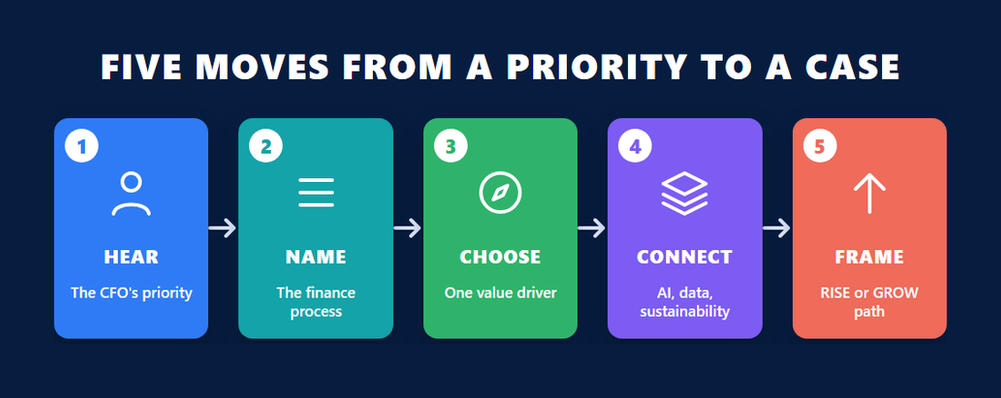
Five moves that turn a priority into a case
- Hear the priority the finance leader actually stated, not the one you expected.
- Name the end-to-end process that priority belongs to.
- Choose one value driver that changes a measurable outcome for that process.
- Connect the supporting layers, embedded AI, governed data and sustainability, only where they strengthen that driver.
- Frame the transformation path, RISE with SAP or GROW with SAP, that fits the customer’s starting point.
The wrong answers in a scenario usually skip one of these moves. Recommending overtime shifts to finish a manual close faster skips the value driver. Exporting the ledger to more spreadsheets skips the process. Leading with a product list skips the priority altogether.
Where do SAP Business AI, Business Data Cloud and Sustainability enter the finance story?
In C_BCFIN, SAP Business AI, SAP Business Data Cloud and SAP Sustainability are not separate pitches but the supporting layers of one finance story: embedded AI moves routine work onto an assistant-led layer, the data cloud grounds analytics and consolidation in governed data, and sustainability extends finance controls to non-financial reporting. Two blueprint areas, SAP Business AI for finance and integration and portfolio synergies, cover this ground.
SAP Business AI for finance
The study guide describes the AI area as explaining how embedded SAP Business AI reshapes finance work, from manual handoffs toward connected, assistant-led execution across record-to-report, receivables, payables and financial planning and analysis. SAP’s own direction is described as all-in on AI, and the course SL_FA250 is dedicated to it.
SAP’s SAP Connect finance announcements in October 2026 give the current picture: an expanded set of Joule Assistants for accounting, revenue recognition, pricing, disclosure management, project operations, governance and trade compliance, embedded into existing workflows while preserving review and accountability. The same article names SAP Pay, a payment service embedded in SAP Cloud ERP and generally available in the United States and the United Kingdom, and says general availability for the Governance Assistant and the International Trade Assistant is planned for the fourth quarter of 2026. In a scenario, that governance angle is the answer to a CFO who asks whether AI agents operate inside the same controls as people.
Business Data Cloud and financial analytics
SAP describes SAP Business Data Cloud as the trusted data foundation for the SAP Business AI Platform, unifying and governing SAP and third-party data through a business data fabric. For finance, the concrete expression announced at SAP Connect is SAP Enterprise Financial Consolidation, built on Business Data Cloud, which brings statutory and management consolidation together with close and disclosure capabilities on one governed foundation, with Early Adopter Care planned for the first quarter of 2027. When a scenario’s CFO complains that planning, consolidation and reporting disagree, this is the layer you position.
Sustainability and the adjacent tools
The integration area also names SAP Sustainability and adjacent tools, SAP Signavio, SAP LeanIX and WalkMe. The positioning logic is the same as for AI and data: sustainability reporting lands on the finance function’s controls and disclosures, process intelligence from Signavio shows where a finance process actually leaks time, LeanIX maps the application landscape a transformation will touch, and WalkMe addresses adoption once the new processes are live. Mention them where the scenario creates a reason; the study guide’s own caution is that scenarios reward showing how the pieces reinforce each other, not listing them.
RISE with SAP or GROW with SAP: which path fits the scenario?
RISE with SAP is the path for a customer modernizing an existing on-premises SAP ERP into the cloud, and GROW with SAP, which SAP’s product page now brands as SAP GROW, is the path for a business starting on cloud ERP. In a C_BCFIN scenario the choice follows the customer’s starting point and transformation goal, and the seventh blueprint area asks you to connect that choice to the finance and sustainability value you have already positioned.
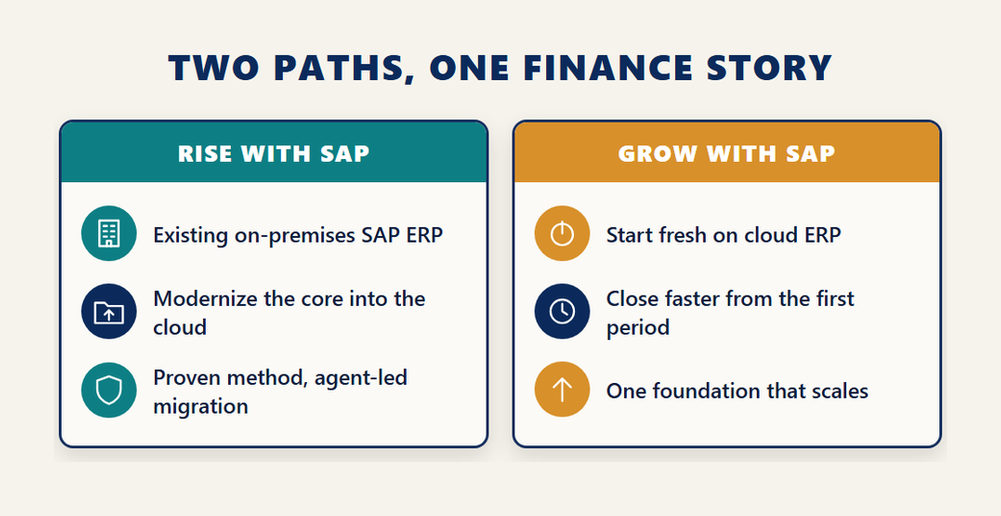
| Question in the scenario | RISE with SAP | GROW with SAP |
|---|---|---|
| Where does the customer start? | An existing on-premises SAP ERP that needs modernizing | No SAP ERP yet, or a business that wants to start fresh in the cloud |
| What does SAP emphasize? | Agent-led transformation, migration and modernization assistants, a proven methodology and expert guidance | One cloud ERP foundation for finance, supply chain and HR with built-in AI, ready to run and scale |
| Finance message that fits | Keep what works, move the core to the cloud, and unlock embedded finance AI on the way | Automate finance to close faster from the first period, with standard processes and built-in AI |
| Typical trend to connect | Cloud ERP as the precondition for AI and the Autonomous Enterprise | Growth without adding complexity, standard processes as a competitive advantage |
The RISE with SAP page frames its offer as transforming an on-premises ERP to the cloud so it can power AI assistants, with a fast path to the Autonomous Enterprise. The SAP GROW page frames its offer as an AI cloud ERP for companies of any size, and leads its finance message with automating the close. Both pages are useful for one reason in this exam: they tell you which words SAP itself uses for each path, and the study guide’s fourth preparation step asks you to link that framing to a customer’s market context.
Reading the signal in the scenario
Scenarios rarely say “this customer should take RISE”. They describe a landscape. A long-standing manufacturer with a heavily customized SAP ERP, a close that depends on custom reports and a board asking for AI is a RISE conversation. A fast-growing company on spreadsheets and a small accounting package, hiring a first finance team, is a GROW conversation. The finance value drivers are the same families in both cases; what changes is how you frame the route to them.
How should you prepare for C_BCFIN?
Prepare for C_BCFIN by working through the four courses of SAP’s Positioning SAP Financial Management Solutions learning journey in order, SL_FIN110, SL_FIN200, SL_FA250 and SL_FIN250, then rehearsing complete positioning scenarios until the move from a customer’s finance priority to a value-led response feels automatic. ERPPrep’s FAQ page puts the journey at about seven hours across the four courses and suggests four to six weeks of preparation alongside a job.
| Course | Title | What it gives you |
|---|---|---|
| SL_FIN110 | Discovering SAP Financial Management Solutions | The CFO persona, the challenges finance leaders face, and how the finance portfolio answers them within the Business Suite |
| SL_FIN200 | Positioning SAP Financial Management Solutions | Where the portfolio sits in the suite, how it maps to industries, where it touches end-to-end processes, and the value a CFO gets |
| SL_FA250 | Introducing SAP Business AI for Finance | How applications, data and AI combine to move routine finance work onto an assistant-led layer, with embedded use cases |
| SL_FIN250 | Selling SAP Financial Management Solutions to CFOs | The customer-conversation capstone; ERPPrep notes its detailed units are gated behind sign-in |
Five steps from the study guide, in order
- Learn the CFO narrative first, the challenges finance leaders face and how the CFO connects across an organization’s buying centers, because every strong positioning answer starts from a clear picture of the customer’s priorities.
- Practise articulating the value drivers of SAP Financial Management within the SAP Business Suite, so you can differentiate the solution’s business value quickly rather than describing features in isolation.
- Rehearse the integration story as one connected message, how the finance solutions work alongside SAP’s AI, data cloud and sustainability offerings, since scenarios often reward showing how the pieces reinforce each other.
- Study the cloud transformation framing through RISE with SAP and GROW with SAP, and practise linking it to a customer’s market context, because recognizing the right trend to emphasize is part of the assessment.
- Work through complete positioning scenarios end to end, moving from the customer’s finance priorities to the right value-led response, so the reasoning feels automatic in a single-activity format.
Rehearse being questioned
Reading the courses is step one. The format rewards judgment you can defend, so the most useful rehearsal is one where a stakeholder pushes back: why that driver and not another, why RISE and not GROW, what the sustainability angle has to do with a close. ERPPrep builds its scenario simulations and skill drills around that pressure, and a colleague playing a skeptical finance director does much the same job for free. The habit to build is the five-move chain above, run quickly and in order, until a stated priority produces a value-led response without a pause.
Older material still circulates. ERPQnA’s earlier C_BCFIN_2502 materials page predates the format change, so use it to orient yourself on the topic names and the three original course titles, and take every exam fact from ERPPrep’s current pages instead.
How does C_BCFIN compare with C_BCSBS, C_BCBTP and C_TS4FI?
C_BCFIN is the finance member of SAP’s positioning family. C_BCSBS positions the Autonomous Enterprise as a whole, C_BCBTP positions the SAP Business AI Platform, and C_TS4FI is the Financial Accounting implementation exam that ERPPrep lists beside C_BCFIN as related. Choose C_BCFIN when your conversations are with finance leaders and your job is to make the value case rather than to configure the system that delivers it.
| Exam | What you position or build | Who it suits |
|---|---|---|
| C_BCFIN | SAP Financial Management solutions within the suite, for a CFO audience | Presales and sales people whose customers are finance leaders |
| C_BCSBS | The Autonomous Enterprise strategy across the whole suite | Sellers who open the conversation at executive level before any line of business |
| C_BCBTP | The SAP Business AI Platform: build, data and AI, governance | Sellers and presales people whose counterpart is the CIO or an architect |
| C_TS4FI | SAP S/4HANA Financial Accounting as an implementation consultant | Consultants who configure and run the finance system |
The positioning exams share a format and a habit of mind, so one of them makes the next easier. If you already hold the suite-level credential, the finance exam asks you to apply the same operating-model story to one persona and four process families. If you are deciding where to start, the broader exam is covered in the C_BCSBS pitch article, which explains the Autonomous Enterprise framing that the market trends area of C_BCFIN also draws on.
ERPPrep’s related list also names C_BCSCX, the Customer Experience positioning exam, and C_C4HCX. The pattern across all of them is the same: one scenario, a 60 percent pass score, and a persona whose priorities you have to hear before you answer.
Frequently Asked Questions
What is the C_BCFIN exam?
C_BCFIN is the SAP Certified – Positioning SAP Business Suite via SAP Financial Management Solutions exam, an Associate level credential for presales and sales professionals. It checks whether you can position SAP Financial Management solutions within the SAP Business Suite for a finance audience, through one Scenario-Based Assessment activity passed at 60 percent.
How many questions does C_BCFIN have?
None in the usual sense. C_BCFIN is a single Scenario-Based Assessment activity, so you work through one realistic customer situation and apply positioning judgment to it rather than answering a bank of separate items. Older guides that quote an item count describe the superseded C_BCFIN_2502 release.
What is the passing score for C_BCFIN?
ERPPrep publishes a passing score of 60 percent on its study guide, FAQ and product pages. SAP’s own certification page for the exam sits behind a login, so the figure cannot be confirmed from a public SAP page, and ERPPrep’s value is the one in use.
How long is the C_BCFIN exam?
No public page publishes a duration for C_BCFIN. ERPPrep’s pages carry none and SAP’s certification page requires a login. Check the duration on SAP’s page once you are signed in, before you book, rather than relying on a figure from an older guide.
Which languages is C_BCFIN offered in?
ERPPrep records the languages as not published by SAP. Confirm availability on SAP’s certification page when you sign in to register, because reading a customer scenario accurately in the exam language matters more here than in a configuration exam.
Do I need SAP system access to prepare for C_BCFIN?
No. ERPPrep’s FAQ states that the exam assesses positioning judgment rather than technical execution in a live SAP environment, so hands-on access is not required. Scenario rehearsal, the CFO narrative, the value drivers and the integration story matter more than transaction skills.
How long should I prepare for C_BCFIN?
ERPPrep’s FAQ suggests roughly four to six weeks alongside a job. The learning journey itself runs about seven hours across four courses, but the scenario format needs extra time for rehearsing applied positioning, especially on the integration and value driver topics.
What are the seven blueprint areas of C_BCFIN?
End-to-end financial management processes; the CFO persona and buying centers; business value drivers and customer value proposition; market trends and SAP finance strategy; SAP Business AI for finance; integration and portfolio synergies; and cloud transformation via RISE and GROW with SAP. ERPPrep publishes no weightings for them.
Is C_BCFIN the same as C_BCFIN_2502?
C_BCFIN_2502 was the release-suffixed earlier version of the credential, delivered in the older format with a different pass mark. The exam ERPPrep describes today carries the bare code C_BCFIN, one Scenario-Based Assessment activity and a 60 percent passing score, following SAP’s move to performance-based certification in early 2026.
Conclusion
C_BCFIN rewards a specific habit: hearing what a finance leader actually said, naming the process it belongs to, choosing the value driver that changes a measurable outcome, connecting AI, data and sustainability only where they strengthen that driver, and framing the transformation path that fits the customer’s starting point. The seven blueprint areas on ERPPrep’s study guide describe that habit from different angles, and the four courses of the learning journey teach it in the order a real conversation runs. Take the exam facts from ERPPrep’s current pages, treat older item-count guides as topic orientation, and spend your remaining weeks rehearsing complete scenarios with someone who pushes back. Positioning SAP Financial Management solutions is a conversation skill, and the exam is built to see whether you have it.


