SAP now runs two certifications for Business Data Cloud, and the one with the grander title is not the one to sit first. SAP Certified – Data Architect – SAP Business Data Cloud asks you to design a landscape. SAP Certified – SAP Business Data Cloud, exam code C_BCBDC, asks whether you understand the platform well enough to join a project team and be useful from week one. For almost everyone, that is the question to answer first.
This article is about the C_BCBDC exam: what it validates, why it is delivered as one Scenario Based Assessment activity rather than a bank of recall items, how its six blueprint areas fit together, what SAP displays and does not display about it, and how to prepare using the four-course learning journey SAP built for it. It also settles the suffix question, because searches for C_BCBDC_2505 and C_BCBDC_2605 still outnumber searches for the code SAP actually uses.
Which SAP Business Data Cloud Certification Should You Take First?
Take C_BCBDC first unless you already design data landscapes for a living. C_BCBDC, SAP Certified – SAP Business Data Cloud, is the associate credential: it proves foundational knowledge of the platform and the ability to contribute as part of a project team. The Data Architect credential, C_BDCDA, sits above it and assumes you can reason about architecture, governance and data value, not only about the platform.
The two exams share a product and a delivery format, which is why they rank side by side and why people confuse them. They do not share an audience. SAP lists Data Analyst, Consultant and Business User as the roles for C_BCBDC, and the learning journey behind it has no prerequisite at all. The architect exam draws on TOGAF, data mesh and data fabric choices and communication of data value, which are senior consultant concerns.
Two credentials, two depths
If your work is building reports, installing intelligent applications, helping a team move its SAP BW content onto the platform or connecting an external tool, C_BCBDC is the credential that describes what you do. If your work is deciding whether a company should run a mesh or a fabric and defending that choice to a board, C_BDCDA is. Most candidates reach the second only after the first, and nothing in SAP’s catalogue requires you to skip ahead.
What Does the C_BCBDC Exam Validate?
The C_BCBDC exam validates foundational, associate-level knowledge of SAP Business Data Cloud: the organisational data problems it exists to solve, its design principles and architecture, the difference between intelligent applications and data products, the path for modernising an existing SAP BW landscape, data subscriptions on SAP BW content, and the open data ecosystem that connects external tools and shares data in both directions.
SAP’s own description is short. The certification provides evidence that you have developed foundational knowledge of SAP Business Data Cloud and the essential skills needed to contribute as part of a project team. The phrase to notice is project team. This is not a credential that says you can run a platform alone; it says you can be handed work on one and understand what the work is for.
The platform itself, as SAP presents it, unifies and governs SAP and third-party data through a business data fabric, and it bundles capabilities you may already know under their own names: SAP Datasphere for modelling and sharing, SAP Analytics Cloud for analytics and planning, SAP Business Warehouse brought to the cloud, SAP HANA Cloud underneath, SAP Master Data Governance for the golden record, and SAP Databricks for custom machine learning. C_BCBDC does not certify any of those products individually. It certifies that you understand how they cooperate inside one platform.
The skills SAP attaches to the credential
SAP’s certification page tags C_BCBDC with three skills: Data Storytelling, Database Management and Analytics. Read together with the roles, that is a fair picture of the exam. It expects you to explain what a data product is for, to know where the data is held and governed, and to connect both to an analytical outcome a business user cares about.
What Does One Scenario Based Assessment Activity Look Like?
C_BCBDC is delivered as a single Scenario Based Assessment activity with a 60 percent pass score and, on SAP’s page, a duration of 2 hours. There is no question count because the format does not have one. You are given a realistic business situation and asked to reason through the decisions a project team member would make, applying platform concepts rather than recognising correct statements.
SAP completed its move to performance-based certification in early 2026, and C_BCBDC is a Scenario-Based Assessment, or SBA, in that scheme. The other 2026 format, the System-Based Assessment, puts you inside a live-style system to carry out configuration tasks; it is used for exams such as the S/4HANA module credentials. An SBA instead tests judgement in context. The scenario describes a company, a landscape and a problem, and the marks go to the candidate who identifies what the situation actually requires.
That design changes how preparation has to work. Reading definitions of intelligent applications and data products will not carry you through a scenario in which a utility company wants to modernise its BW system without interrupting regulator-facing reporting. Rehearsing situations will. ERPPrep’s C_BCBDC scenario simulations are built on that format: 24 multi-phase scenarios ordered from foundation to advanced, alongside 242 skill drills across the six areas, so you practise defending a decision rather than recalling a term.
What the 60 percent cut measures
A 60 percent pass score on a scenario activity is not a 60 percent score on a bank of items. It reflects how much of the applied reasoning across the activity was sound. Because one activity has to stand in for six blueprint areas, a candidate who knows four areas well and two not at all can fail a scenario that happens to turn on the missing two. Breadth matters more here than depth in a favourite topic.
SAP also asks you to prepare for the mechanics. Its page points to a Technical Readiness Checklist for hardware, software and connectivity, to the Learning Hub subscription and SAP Universal ID you need before booking, and to an introduction to scenario-based assessments plus an AI-powered scenario practice tool you can try before exam day. Use all three; the format is new enough that the interface itself should hold no surprises.
How Are the Six C_BCBDC Blueprint Areas Organised?
ERPPrep’s study guide organises the C_BCBDC exam into six blueprint areas: SAP Business Data Cloud Fundamentals and Architecture; Intelligent Applications and Data Products; Provisioning and Enabling the Platform; SAP BW Modernization; Data Subscriptions on SAP BW Content; and Open Data Ecosystem and Data Sharing. SAP displays no weightings for this exam, so no area can be treated as safe to skip.
The six areas follow a logical order that is worth keeping in your study plan. The first builds the picture everything else rests on. The second introduces the two things you actually consume on the platform. The third covers getting a working environment, called a formation, provisioned and its users enabled. The fourth and fifth deal with an existing SAP BW estate. The sixth opens the platform outward to tools that are not SAP’s.
| Blueprint area | What it asks you to understand |
|---|---|
| SAP Business Data Cloud Fundamentals & Architecture | The organisational data challenges the platform solves, its core design principles and how its overall architecture is structured |
| Intelligent Applications & Data Products | What each is, how they differ, and the role each plays in turning enterprise data into ready-to-use operational insight |
| Provisioning & Enabling the Platform | Preparing and provisioning the platform’s components, assembling a formation and enabling users |
| SAP BW Modernization | Applying the Optimize-Modernize-Innovate approach, including relocating a BW system to the private cloud edition hosted within the platform |
| Data Subscriptions on SAP BW Content | Using the generator tooling to define, run, schedule, maintain and transport subscriptions built from SAP BW objects |
| Open Data Ecosystem & Data Sharing | Connecting external tools, provisioning OEM components, creating BDC Connect connections and sharing data products out of and back into the platform |
Why ERPPrep’s drill grouping looks different
If you open the ERPPrep product page you will see six skill domains with slightly different names: the two BW areas are merged into SAP BW Modernization and Transformation, and a sixth domain called Use-Cases and Business Value appears instead. That is a drill grouping, built so that the 242 skill drills can be trained by domain, not a second syllabus. The blueprint above is the list to plan by; the drill domains are the list to practise by. Both cover the same ground.
Intelligent Applications or Data Products: The Distinction Scenarios Hinge On
A data product is a curated, governed, reusable dataset the platform delivers, built on SAP’s own business process definitions and ready to be consumed, shared or extended. An intelligent application is a finished analytical experience built on top of such products for a specific decision, such as finance or spend intelligence. C_BCBDC scenarios repeatedly turn on choosing the right one for a business need.
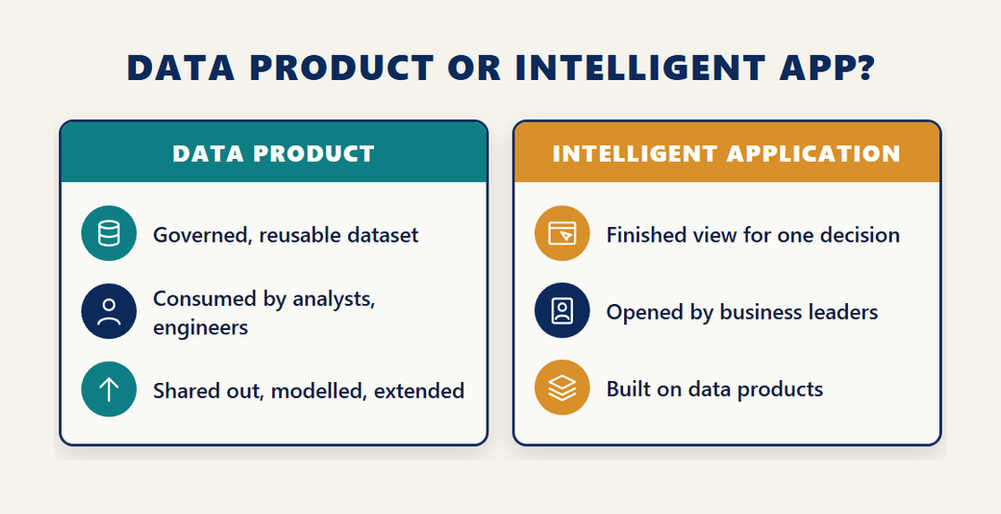
The exam wants you to know how each is discovered, installed and extended. Both arrive through the platform’s catalogue. A data product is something a data engineer or analyst can subscribe to, model against in SAP Datasphere, share outward through the open ecosystem, or generate for themselves from SAP BW content. An intelligent application is something a business leader opens: SAP’s October 2025 SAP Connect announcements previewed four of them, for finance, spend, supply chain and revenue, each harmonising SAP and external data and suggesting actions.
The mistake ERPPrep’s FAQ names as the most common is treating the two as interchangeable. They are not. A scenario that asks how a procurement team should get a single classified view of spend is pointing at an intelligent application. A scenario that asks how a machine learning team should get governed access to sales order data in SAP Databricks is pointing at a data product. Read for the consumer of the data, and the choice usually follows.
Where provisioning fits in
Neither can be used until the platform has been provisioned and a formation assembled, which is why the third blueprint area sits between the two conceptual areas and the BW work. Scenarios in which a run produces no output, or a user cannot see a product, are often provisioning questions in disguise: a formation not yet assembled, a user not yet enabled, a component not yet provisioned. Learn the order of those steps as a sequence, because the scenario will test whether you know what has to exist first.
What Is the Optimize, Modernize, Innovate Path for SAP BW?
Optimize, Modernize, Innovate is the ordered path C_BCBDC expects you to apply to an existing SAP BW landscape: first get the current system in shape, then move it to SAP BW private cloud edition hosted within SAP Business Data Cloud, then build new capability on the platform around it. Two of the six blueprint areas sit on this path, so it carries real weight in the exam.
The reason the path is staged rather than a single cutover is the point most scenarios probe. A BW system that runs regulatory or board reporting cannot be switched off while a new platform is built. Preserving the value already in BW before adding anything new lowers the disruption risk, and the modernize step is specifically the relocation of the existing system into the private cloud edition inside the platform, not a rewrite of every report somewhere else and not a freeze.
Innovate is what follows, and the exam expects you to know that the modernised state is a beginning rather than an endpoint: SAP managed data products, SAP Datasphere modelling and planning scenarios all become available once the landscape is on the platform. Candidates who describe the move to the private cloud edition as the destination tend to lose the thread here.
Data subscriptions on BW content
The fifth blueprint area is the practical half of modernisation. A data subscription takes an SAP BW object and publishes it as a consumable data product on the platform. It is not a one-time load. The study guide describes a lifecycle you have to manage in order: define the subscription on the BW object, run it, schedule it, maintain it and transport it between systems. ERPPrep’s sample scenarios lean on exactly that order, for example a subscription that produced no output because it was run before it had been defined, or figures that drifted stale because a single run was treated as the end of the job.
How Does the Open Data Ecosystem Share Data In and Out?
The open data ecosystem is how SAP Business Data Cloud works with platforms SAP does not own. The sixth blueprint area covers connecting external tools, provisioning OEM components such as SAP Databricks, creating SAP Business Data Cloud Connect connections, and sharing data products both out to another platform and back into SAP’s. C_BCBDC tests the connection patterns and when each applies, not the engineering underneath them.
The mechanism SAP has built this on is zero-copy sharing: a data product stays where it is governed and the external platform reads it in place, so there is no duplicated dataset to keep in step. Through 2025 SAP announced SAP Business Data Cloud Connect for Databricks as generally available, Google as a public preview, and in November a connection to Microsoft Fabric, planned for general availability in the third quarter of 2026, that shares in both directions with Microsoft Fabric and OneLake.
“By bringing SAP Business Data Cloud and Microsoft Fabric closer together, our customers can seamlessly leverage the power of data to generate real business value through AI and analytics.”
For the exam, the detail to hold on to is the direction of travel. Sharing out lets a data science team work on SAP data products in the platform it already uses; sharing back in lets a dataset built elsewhere supplement an intelligent application inside SAP Business Data Cloud. Scenarios about machine learning in SAP Databricks are the most common form of the first; scenarios about enriching a finance view with external data are the usual form of the second.
SAP’s wider product framing
SAP’s product page describes the platform as a business data fabric that gives agentic AI a trusted foundation, and it positions the open ecosystem as the way that foundation extends beyond SAP’s own estate. You do not need the marketing language for the exam, but you do need the idea behind it: data products carry their business context with them wherever they are shared, and that context is what makes the sharing worth doing. SAP’s platform overview lists every capability the exam touches on one page and is worth a read before the architecture area.
What Are the C_BCBDC Exam Facts?
C_BCBDC is an associate-level SAP certification delivered as one Scenario Based Assessment activity, passed at 60 percent, with a displayed duration of 2 hours. Its languages depend on the assessment format you choose, and it maps to a single learning journey with no prerequisite. SAP displays no fee, no question count, no topic weightings and no validity period on the certification page, and ERPPrep publishes none of those either.
| Fact | Value | Source |
|---|---|---|
| Credential | SAP Certified – SAP Business Data Cloud | SAP and ERPPrep |
| Exam code | C_BCBDC (no suffix on SAP’s page) | SAP and ERPPrep |
| Level | Associate | ERPPrep |
| Format | Scenario Based Assessment, 1 activity | SAP and ERPPrep |
| Passing score | 60 percent | SAP and ERPPrep |
| Duration | 2 hours | SAP (ERPPrep publishes none) |
| Languages | Vary by format: Roleplay with AI guidance in English, Spanish, Italian, French, Japanese and 25 more; Record a video in English only | SAP |
| Blueprint areas | Six, unweighted | ERPPrep study guide |
| Learning journey | Exploring SAP Business Data Cloud, prerequisite none | SAP |
| Roles | Data Analyst, Consultant, Business User | SAP |
| Fee, question count, weightings, validity | Not displayed | SAP and ERPPrep |
C_BCBDC_2505, C_BCBDC_2605 and the code SAP uses
SAP’s certification page displays the exam code as C_BCBDC, with no year suffix. Search data shows people still typing C_BCBDC_2505, which was the suffixed 2025 release, and C_BCBDC_2605, for which no SAP page exists. Material written under the 2505 code describes an earlier shape of the exam, and some third-party pages still quote a timed set of recall items with a different cut score. If a course, a listing or an older article carries a suffix, treat it as describing a previous version and check the current format against SAP’s page before relying on it.
Languages are a format choice
The language rule is easy to misread. SAP does not list a single exam language for C_BCBDC. Instead it displays that available languages vary by format: the Roleplay with AI guidance option is offered in English, Spanish, Italian, French, Japanese and 25 more languages, while the Record a video option is English only. A candidate who prefers to work in a language other than English therefore has to choose the roleplay format. ERPPrep’s page lists English alone, which is correct for the video format but not the whole picture.
How Should You Prepare for C_BCBDC?
Prepare for C_BCBDC by working through SAP’s four-course learning journey, Exploring SAP Business Data Cloud, in order, then rehearsing scenarios until you can explain why a given platform choice fits a given business situation. ERPPrep estimates four to six weeks alongside a job; candidates with an analytics background can compress that, and newcomers should take the full range.
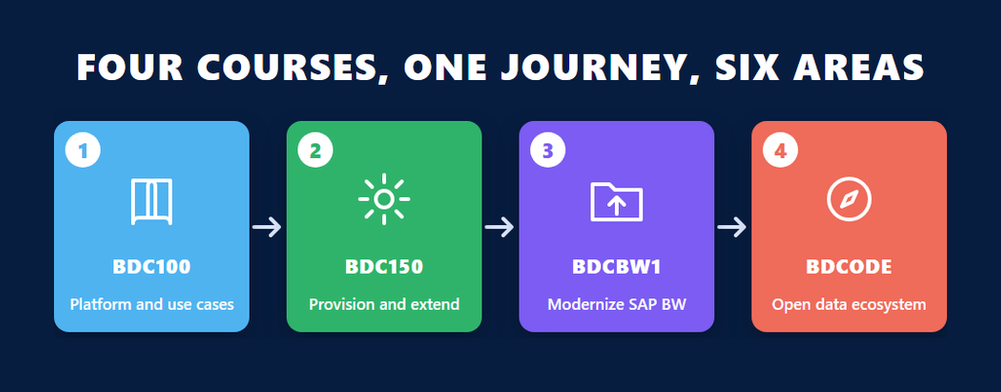
The journey has no prerequisite, and its four courses map almost one to one onto the blueprint. BDC100, Introducing SAP Business Data Cloud, covers the challenges, principles, architecture and use cases. BDC150, Developing Detailed Knowledge of SAP Business Data Cloud, goes into provisioning, formations, user enablement and the hands-on side of intelligent applications and data products. BDCBW1, Transforming SAP BW with SAP Business Data Cloud, is the modernisation path and data subscriptions. BDCODE, Introducing the Open Data Ecosystem for SAP Business Data Cloud, is the sixth area. The four-course SAP journey lists Business User, Consultant, Data Analyst and Data Scientist as its roles.
A study order built for one scenario
- Study SAP Business Data Cloud as one connected platform, linking its architecture, design principles and use cases together so you can reason about how the pieces cooperate rather than recalling each in isolation.
- Get comfortable distinguishing intelligent applications from data products, including how each is discovered, installed and extended, since scenarios often hinge on choosing the right one for a given business need.
- Trace the SAP BW modernisation path deliberately, because the Optimize, Modernize, Innovate idea and the move to the BW private cloud edition recur, and practise explaining why an organisation would take each step.
- Learn the open data ecosystem in practical terms, including how external tools connect, how BDC Connect links landscapes and how data is shared in and out, because these patterns appear as realistic scenario decisions.
- Ground every concept in a concrete use case, such as delivering operational insight or sharing data with SAP Databricks for machine learning, so scenario questions map onto situations you have already reasoned through.
SAP also runs a Get Certified live session series for C_BCBDC: a kick-off that walks through the certification format and exam interface, followed by content review sessions for each course in the journey. Those sessions complement self-study rather than replacing it, and they are the place to ask an SAP trainer the questions the courses leave open. Hands-on system access helps but is not required at this level; conceptual clarity and scenario rehearsal matter more. An earlier Business Data Cloud preparation guide on this site walks the same journey from the course side.
What to do in the last week
Stop reading and start rehearsing. Take full scenarios end to end under a clock, write down the requirement you think the situation is really asking for before you choose, and check that reading against the outcome. The single activity rewards a candidate who confirms their interpretation before committing, and that habit is built in the last week, not the first.
Who Hires for SAP Business Data Cloud Skills?
Employers hiring for SAP Business Data Cloud skills are the same organisations running SAP S/4HANA, SAP BW and SAP Analytics Cloud today and now consolidating that data for analytics and AI. SAP names Data Analyst, Consultant and Business User as the roles for C_BCBDC, and the journey adds Data Scientist. The credential signals you can take platform work on a team rather than lead it.
For a data analyst, C_BCBDC is a way to show familiarity with the platform that is replacing the warehouse their reports currently sit on. PayScale puts the US data analyst salary at an average base of $70,643 a year across 11,864 profiles, and SAP platform knowledge is one of the specialisms that moves a profile toward the top of that range. For an SAP consultant, the credential is the entry point to a product SAP is positioning at the centre of its AI story, with the architect credential as the next step.
Because the platform is young, the market has more roles than certified people, and most of the demand comes from existing SAP customers modernising BW rather than from greenfield projects. That is why two of the six blueprint areas concern SAP BW. Candidates who already know BW have a head start on exactly the part of the exam employers care about most.
What trips people up
The failures are predictable: memorising definitions instead of connecting them, skipping the architecture and BW areas because they feel abstract, and treating intelligent applications and data products as one thing. A short piece on this site on the common C_BCBDC mistakes was written under the earlier 2505 code; the habits it describes still cost marks in the scenario format, even though the format it assumes has been replaced.
Frequently Asked Questions
Is C_BCBDC the same as the SAP Data Architect certification?
No. C_BCBDC is SAP Certified – SAP Business Data Cloud, the associate credential for foundational platform knowledge. The Data Architect credential, C_BDCDA, is a separate exam for people who design data landscapes and defend architecture and governance choices. Both are Scenario Based Assessments on the same product, and most candidates take C_BCBDC first.
What is the C_BCBDC exam format?
One Scenario Based Assessment activity. You work through a realistic business situation and apply SAP Business Data Cloud concepts to the decisions it raises. There is no question count, because the format does not consist of separate items. SAP and ERPPrep both describe it this way.
What is the passing score for C_BCBDC?
60 percent, displayed by SAP and published by ERPPrep. Because the exam is one activity covering six unweighted blueprint areas, the score reflects how sound your reasoning was across the whole scenario, so broad coverage matters more than depth in one area.
How long is the C_BCBDC exam?
SAP’s certification page displays a duration of 2 hours. ERPPrep does not publish a duration for this exam. Plan rehearsal around two hours of sustained reasoning rather than a sprint through short items.
Is C_BCBDC_2605 the current exam code?
SAP’s page displays the code as C_BCBDC with no suffix, and no SAP page carries a 2605 suffix. C_BCBDC_2505 was the earlier suffixed release. Treat any suffixed code as a sign that the material describes a previous version and confirm the current format on SAP’s certification page.
Which languages is the C_BCBDC exam available in?
It depends on the format you choose. SAP displays that the Roleplay with AI guidance option is available in English, Spanish, Italian, French, Japanese and 25 more languages, while the Record a video option is English only. ERPPrep lists English.
How much does the C_BCBDC certification cost?
Neither SAP’s certification page nor ERPPrep displays a fee for C_BCBDC. SAP requires a Learning Hub subscription that includes certification exam attempts, plus a valid SAP Universal ID, and the exam page shows your available attempts. Check the subscription options on SAP’s site for pricing in your region.
Which courses prepare for C_BCBDC?
The Exploring SAP Business Data Cloud learning journey: BDC100 Introducing SAP Business Data Cloud, BDC150 Developing Detailed Knowledge of SAP Business Data Cloud, BDCBW1 Transforming SAP BW with SAP Business Data Cloud, and BDCODE Introducing the Open Data Ecosystem for SAP Business Data Cloud. The journey has no prerequisite.
Do I need SAP experience to pass C_BCBDC?
No prior SAP experience is required, and the learning journey has no prerequisite. The credential targets a foundational, team-contributor level. Familiarity with data modelling, reporting or SAP BW makes the architecture and modernisation areas easier, and hands-on access helps but is not required.
Conclusion
C_BCBDC is the first SAP Business Data Cloud credential for a reason: it certifies the knowledge a project team member needs before the architecture questions arrive. One Scenario Based Assessment activity, a 60 percent pass score and a displayed 2 hours stand in for six blueprint areas that run from the platform’s architecture, through intelligent applications and data products and the modernisation of SAP BW, to an open ecosystem that shares data with Databricks, Google and Microsoft Fabric in place. Work the four-course journey in order, learn the distinctions the scenarios hinge on, rehearse full situations under a clock, and book the exam under the code SAP actually displays. The architect credential can wait until this one is done.


