
C_ABAPD is the code for SAP Certified – Backend Developer – ABAP Cloud, an associate-level credential that no longer works the way SAP certification used to. It is delivered as a System-Based Assessment: one guided, hands-on activity carried out inside a working ABAP development environment, scored on whether you completed the task correctly. The cut score is 67 percent, delivery is in English, and the credential is currently offered as a Beta Version while SAP calibrates it.
That format change is the whole story of this exam, and most of the guidance still online was written for the older approach. This guide explains what a System-Based Assessment involves, walks the seven blueprint areas ABAP Cloud covers, sets out why the RESTful Application Programming Model and Core Data Services catch experienced developers out, and gives a realistic timeline built on hands-on build time rather than reading hours.
What Is the ABAP Cloud Developer Certification?
C_ABAPD certifies that you can build business applications with modern, cloud-ready ABAP as a mentored member of a project team. It covers language fundamentals, object-oriented design, database access through ABAP SQL and Core Data Services, transactional applications built with the RESTful Application Programming Model, and Clean Core extensibility for SAP S/4HANA Cloud. It centres on the SAP BTP ABAP environment. The front end counterpart runs on the same assessment model, as the C_FIORD exam format shows.
The word “mentored” is doing real work in that description. This is an associate credential, and SAP is explicit that the target profile is someone who contributes effectively to an implementation project under guidance rather than someone who architects it. The scope is wide, but the expected depth is that of a capable contributor. Developers who work in Node.js or Java rather than ABAP have a parallel route in the SAP CAP developer certification.
“The modern version of the development model is ABAP Cloud, which has been developed from the outset according to the guiding principles of openness and comprehensive support for the business logic.”
The skills transfer further than the exam’s stated environment. Because the courses behind it are written to apply across deployments, what you learn for the SAP BTP ABAP environment carries over to SAP S/4HANA Cloud and to SAP S/4HANA 2020 and later. That makes the credential useful to developers working on private-edition and on-premise projects as well. The same assessment model now governs the C_CPI integration developer exam.
What Does a System-Based Assessment Actually Involve?
A System-Based Assessment, or SyBA, hands you a single guided activity and a working ABAP development environment, and asks you to complete real development tasks inside it. You are scored on whether the task was carried out correctly. It is not a recall exercise, and it is not a fixed bank of items you can memorise your way through. Teams splitting work between pro-code and citizen development often pair it with the SAP Build low-code exam.
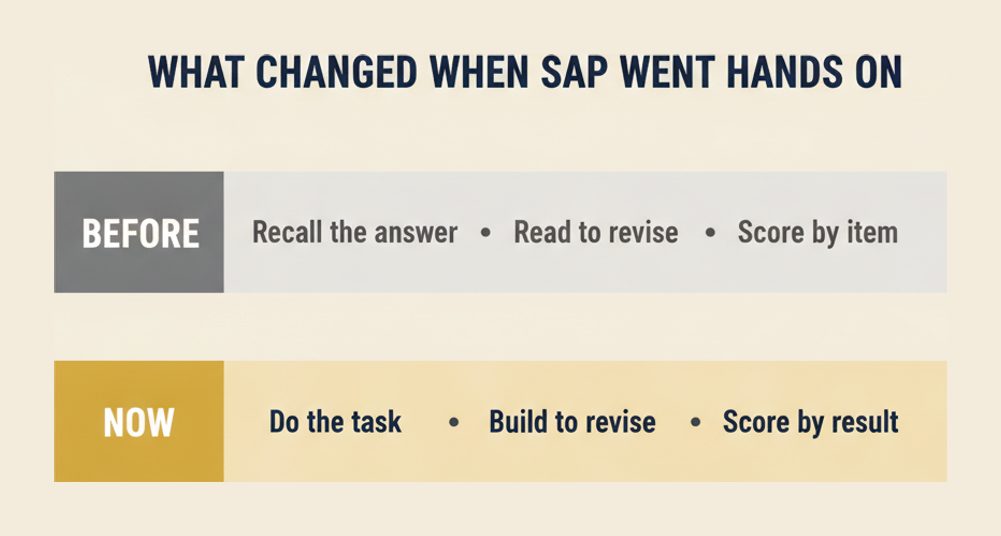
What changes for the candidate
Three things change immediately. First, you cannot pass by recognising correct answers, because there are no answers to recognise. Second, speed matters differently: you are producing working results under time pressure rather than reading and selecting. Third, tooling fluency becomes part of the exam. Knowing where things live in the development environment is no longer preparation for the test, it is the test. SAP states that you complete the exam in your own installation of Eclipse and ABAP Development Tools, and asks that both are on the highest available release before you start. The ABAP environment itself runs on SAP Business Technology Platform, and the BTP platform administration credential covers the people who set up and govern that platform.
The practical consequence is that reading is now the smallest part of preparation. Developers with real coding experience generally find the assessment manageable. Those who studied by reading alone tend to struggle at the moment they are asked to produce something that runs. The full format description sits on the C_ABAPD exam page if you want the specifics before committing.
Why SAP made the change
SAP completed its move to performance-based certification in early 2026, replacing recall-driven assessment across its portfolio with formats that measure applied capability. For a developer credential that shift is unusually well matched: writing ABAP is a doing skill, and an assessment that watches you do it is a more honest measure than one that asks you to describe it. Fiori administration moved the same way, and the C_FIOAD exam format describes the single connected activity it now uses.
What Do the Seven Blueprint Areas Cover?
C_ABAPD publishes seven blueprint areas and no percentage weightings. They run from language core through object orientation, database access, data modeling, RAP and Clean Core extensibility, finishing with code quality, testing and AI-assisted development. Each area builds on the ones before it, which is why the recommended course order matters.
The seven areas
- ABAP Language Core and Development Environment: tooling setup, data objects and types, control structures, string and character processing, date and time handling, internal tables, software structure, transport logistics and debugging.
- Object-Oriented ABAP: local and global classes, instances, methods, encapsulation, inheritance, interfaces, factory methods, and defining and raising your own exception classes.
- Database Access, ABAP SQL and Code Pushdown: SELECT statements, joins, expressions, built-in functions, sorting and aggregation, and moving calculation into the database layer.
- Data Modeling with the ABAP Dictionary and Core Data Services: tables, domains, data elements, structures and table types, then CDS views with annotations, associations, path expressions, input parameters and metadata extensions.
- ABAP RESTful Application Programming Model: the architecture, analysing a business object, adding behaviour with the Entity Manipulation Language, and improving the experience of the resulting OData service.
- Clean Core Extensibility for SAP S/4HANA Cloud: key-user, developer and side-by-side extensibility, released APIs, ABAP Cloud reuse services, and adapting or replacing legacy custom code during a conversion.
- Code Quality, Testing and AI-Assisted Development: the ABAP Test Cockpit, ABAP Unit, runtime profiling, SQL trace analysis, documentation, and using Joule to generate unit tests and accelerate work.
Because no weightings are published, treat all seven as live and let the reported difficulty rather than assumed weight guide your time. In practice that means the middle of the list, data modeling and RAP, deserves the largest share.
Why Do RAP, CDS and Code Pushdown Catch People Out?
Candidates consistently report the RESTful Application Programming Model, CDS data modeling and code pushdown as the hardest parts of C_ABAPD. All three share a property that makes them difficult in a hands-on assessment: a decision made early changes results much later, so a small modeling mistake surfaces as a broken service rather than as a wrong answer.
RAP is an end-to-end skill
RAP is not a topic you can revise in pieces. A working transaction needs a CDS data model, a behaviour definition, logic added through the Entity Manipulation Language, and an exposed service, all consistent with each other. Studying each element separately produces a candidate who recognises all four and can assemble none. The official RAP documentation is the reference, but reading it is not preparation. Building one complete transaction is.
CDS rewards precision
Associations, annotations and path expressions are unforgiving in a way that procedural ABAP is not. An association defined at the wrong cardinality or an annotation applied at the wrong level produces something that compiles and behaves wrongly. That is exactly the failure mode a System-Based Assessment surfaces and a recall exam never would.
Code pushdown is a judgement call
Pushing logic down into ABAP SQL and CDS views reduces data transfer between application server and database, and the exam expects you to know when that is worth doing. The trap is treating pushdown as always correct. Some logic belongs in the application layer, and choosing well is the skill being measured.
What Does Clean Core Extensibility Mean in Practice?
Clean Core extensibility means extending SAP S/4HANA Cloud without modifying the standard core, so upgrades stay clean and cheap. C_ABAPD asks you to evaluate three extensibility routes, key-user, developer and side-by-side, to work with released APIs and ABAP Cloud reuse services, and to adapt or replace legacy custom code during a system conversion.
Choosing the route is the exam question
All three routes work for many requirements, and the assessment cares which one you pick. Key-user extensibility suits configuration-level change made by a business expert. Developer extensibility suits ABAP built inside the system against released APIs. Side-by-side suits anything that genuinely belongs outside the core, typically on SAP BTP. Reaching for developer extensibility because it is familiar is the classic mistake.
The legacy code problem
The conversion objective is where this area gets practical. Existing custom code frequently touches things that are no longer released, and the exam expects you to know how to identify that, find the released alternative, and decide between adapting and rewriting. This is judgement work that only reads as obvious once you have done it on a real system.
Where Does Joule Fit Into an ABAP Exam?
Joule is SAP’s generative AI developer assistant, and C_ABAPD names it inside the code quality and testing area. You are expected to be able to use it to generate unit tests, explain existing code and accelerate routine work. It sits alongside the ABAP Test Cockpit, ABAP Unit, runtime profiling and SQL trace analysis rather than replacing any of them.
Assisted, not automated
SAP’s own position on AI-generated code is that plausible-looking output can carry subtle errors, so it pairs agent testing with human review and leaves the judgement calls to the developer. That framing is the right one to bring into the assessment: the tooling can accelerate you, and you are still accountable for what runs.
The wider tooling picture has moved quickly. SAP has published an ABAP server for the Model Context Protocol so AI agents can interact with ABAP systems through an open standard, and from Q2 2026 ABAP development became possible in Visual Studio Code alongside Eclipse. Neither is examined directly, but SAP’s own account explains why an AI-assisted development area exists on an ABAP blueprint at all.
For the exam itself, the useful skill is narrow and concrete: generating a unit test you then read critically, rather than generating an implementation you hope is right. Anyone mapping the whole track rather than a single area will find the ABAP Cloud preparation guide a useful overview of how the pieces connect.
What Score Do You Need and What Does Beta Version Mean?
The published cut score for C_ABAPD is 67 percent, which sits above the 60 percent floor common to SAP associate credentials. The assessment is a single hands-on activity, delivered in English, on the SAP BTP ABAP environment, and SAP lists its duration as 3 hours. It is currently offered as a Beta Version, which is an early-release state rather than a retirement or replacement.
| Detail | Value |
|---|---|
| Credential | SAP Certified – Backend Developer – ABAP Cloud (Beta Version) |
| Exam code | C_ABAPD |
| Level | Associate |
| Format | System-Based Assessment (SyBA), one activity |
| Duration | 3 hours |
| Passing score | 67 percent |
| Language | English |
| Product focus | SAP BTP, ABAP environment |
Reading the 67 percent correctly
A cut score set above the usual associate threshold is a statement about breadth. SAP tunes each threshold to the competency it wants certified, and 67 percent says a passing developer should be dependably capable across the whole ABAP Cloud scope rather than strong in two areas. On a single-activity assessment that translates into consistent execution rather than a good run in a favourite topic.
What Beta changes
During a Beta release SAP is still calibrating content, scoring and result timing, so results are often confirmed after a review period rather than immediately. The credential is no less valuable once earned; it simply means the registration details deserve a careful read, and that SAP’s own credential page is the authority for any change in status.
How Long Does C_ABAPD Preparation Really Take?
Plan for two to three months alongside a job. The recommended learning journey runs roughly 48 hours across four courses, and hands-on build time has to be added on top of that, not carved out of it. Front-load the language and object-oriented basics, then spend the bulk of your time actually building, because the assessment measures what you can do in the system.
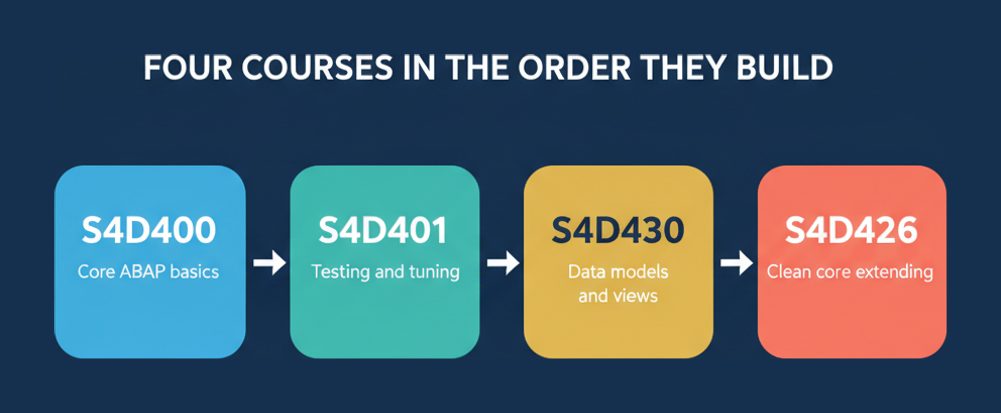
- Start with S4D400 to build the core ABAP foundation: tooling, data objects, control logic, local classes and a first look at database access and RAP.
- Move to S4D401 for the analysis and testing tools, type handling, character processing, code pushdown, internal-table performance, authorisation checks and exception classes.
- Take S4D430 for data modeling, defining Dictionary objects first and then building CDS views with associations, annotations and pushdown.
- Finish the courses with S4D426 for Clean Core extensibility on SAP S/4HANA Cloud, practising the choice between key-user, developer and side-by-side routes.
- Build one complete RAP transaction end to end, pairing a CDS model with a behaviour definition, adding logic, exposing the service and testing it.
- Break something on purpose and fix it using the ABAP Test Cockpit, ABAP Unit, profiling and SQL trace, since diagnosis under time pressure is what the assessment rewards.
- Rehearse full scenario simulations against the clock so that producing verified, working results feels routine rather than rushed.
Prior ABAP experience is not a formal requirement, and the learning journey starts from basic programming, so a determined newcomer can build the foundation. It does make a real difference though, and candidates without a coding background should budget extra practical time rather than extra reading. SAP publishes an official sample repository, and the RAP100 exercise repository is the fastest way to build a working transaction without designing one from scratch.
Candidates who prepared for the earlier version of this credential will find the scope familiar and the method different. The write-up on an earlier C_ABAPD route is still useful for the topic map, provided you read it knowing the assessment method has changed.
Frequently Asked Questions
What format is the C_ABAPD exam?
C_ABAPD is a System-Based Assessment consisting of one guided hands-on activity. You carry out real development tasks inside a working ABAP environment and are scored on whether each task was completed correctly. It measures whether you can write, model and test code rather than whether you can recognise a correct description.
What is the passing score for the ABAP Cloud developer certification?
The published cut score is 67 percent, which sits above the 60 percent floor common to SAP associate credentials. Because the assessment is hands-on, reaching it depends on executing tasks reliably in the system rather than on scoring well in a familiar topic area.
Is prior ABAP experience required for C_ABAPD?
No, it is not a formal prerequisite, and the recommended learning journey starts from basic programming. In practice it makes a substantial difference, because the assessment favours anyone who has already written, tested and debugged code in the environment. Newcomers should budget extra hands-on time.
Which topics do candidates find hardest on the ABAP Cloud exam?
The RESTful Application Programming Model, CDS data modeling and code pushdown. All three share the same difficulty: an early modeling decision changes results later, so a small mistake surfaces as a broken service. Practising them together works better than studying each in isolation.
What does it mean that C_ABAPD is a Beta Version?
Beta means the credential is in an early release phase while SAP finalises and calibrates it. Content, scoring and result timing can differ from a fully released exam, and results are often confirmed after a review period. The credential is no less valuable once earned.
Which SAP product does the ABAP Cloud certification focus on?
The SAP BTP ABAP environment, which is part of the ABAP Platform. The skills carry across to SAP S/4HANA Cloud and to SAP S/4HANA 2020 and later, because the underlying courses are written to apply across those deployments rather than to a single one.
How long should I plan to prepare for C_ABAPD?
Two to three months alongside a job is realistic. The recommended learning journey is roughly 48 hours across four courses, and hands-on build time has to be added on top. Most of that time should go on building CDS views, RAP services and extensions rather than on reading.
Is Joule tested on the C_ABAPD exam?
Yes, within the code quality and testing area. You are expected to be able to use SAP’s generative AI developer assistant to generate unit tests, explain code and accelerate routine work. It sits alongside the ABAP Test Cockpit, ABAP Unit and profiling rather than replacing them.
What is Clean Core extensibility?
Extending SAP S/4HANA Cloud without modifying the standard core, so upgrades stay straightforward. The exam asks you to choose between key-user, developer and side-by-side extensibility, to use released APIs and ABAP Cloud reuse services, and to adapt legacy custom code during a conversion.
Is the ABAP Cloud developer certification worth it?
It is worth it if you write ABAP professionally and want a current credential that reflects how SAP now assesses developers. Because it is performance based, it says something a recall-era certificate could not: that you produced working code in a live environment under time pressure.
Conclusion
C_ABAPD is best understood as a change of method rather than a change of scope. The seven blueprint areas cover the ABAP Cloud stack you would expect, but the System-Based Assessment means preparation has to be built around producing working results rather than around recognising correct ones. RAP, CDS and code pushdown are where that difference bites hardest, and they are also where the reported difficulty concentrates.
Work the four courses in order, then spend the larger share of your time building one complete transaction and breaking it deliberately. Two to three months alongside a job is realistic, and running full scenario simulations against the clock is the surest way to know whether 67 percent is within reach. If you are weighing the effort against the return, independent salary data gives an honest sense of where the role sits in the market.


